Supplement claim substantiation is the process of gathering and documenting scientific evidence showing that a label or marketing claim is truthful, not misleading, and supported by the product actually being sold. Under U.S. law, a company making a structure/function claim must hold that evidence before the claim goes to market. In practice, this means brands and their manufacturing partners need an evidence file, not just a persuasive label.
The stakes are practical. Weak substantiation leads to regulatory letters, retailer delistings, class actions and costly relabeling. Strong substantiation does the opposite: it speeds retailer approvals, supports confident marketing and gives your manufacturer a clear brief for formulation, dosing and testing. This guide explains how claims are categorized, what FDA and FTC expect, how to match evidence to a specific product, and how to build a defensible claims file.
What is claim substantiation for dietary supplements?
The Federal Food, Drug, and Cosmetic Act requires a manufacturer making a nutritional deficiency, structure/function or general well-being claim to have substantiation that the claim is truthful and not misleading. FDA’s guidance on the topic notes that the FTC has typically applied a standard of “competent and reliable scientific evidence” to claims about the benefits and safety of dietary supplements and other health-related products.
Substantiation applies to every claim a consumer or retailer might reasonably take from your materials, including:
- Express claims on the label, such as “supports joint comfort”
- Implied claims created by product names, imagery, icons and testimonials
- Claims in advertising, websites, marketplace listings, social media and influencer posts
- Quantity claims, such as the amount of an active ingredient per serving
The last item connects substantiation to manufacturing quality. A label can only be accurate if the finished product actually contains what it says, which is why finished-batch testing under 21 CFR Part 111 matters for claims as well as compliance.
The main types of supplement claims
Which claim you make determines which rules apply and how much evidence you need. In the United States, supplement claims fall into a few categories:
| Claim type | Example | What it requires |
|---|---|---|
| Nutrient content | “Good source of fiber” | Meeting defined criteria for the nutrient and accurate label values |
| Structure/function | “Vitamin C helps support immune health” | Substantiation, FDA notification within 30 days of marketing, and the required disclaimer |
| Health claim | Link between a nutrient and reduced risk of a disease | FDA authorization or qualified-claim process; much stricter than structure/function |
| Disease claim | “Treats arthritis” or “prevents dementia” | Not allowed on dietary supplements; pushes the product into drug territory |
A structure/function claim describes the role of a nutrient or dietary ingredient in affecting the normal structure or function of the human body, such as “Vitamin C helps support immune health.” The line between a structure/function claim and a disease claim is where many companies get into trouble. As a rule of thumb, structure/function claims focus on positive health, while disease claims, expressly or by implication, center on a negative disease condition.
Enforcement agencies check this line. A federal inspector general review of weight-loss and immune-support supplements found that 20 percent included prohibited disease claims and 7 percent lacked the required disclaimer. Testimonials are another trap: in one annual review of FDA warning letters, testimonials containing disease statements were cited as violations.
Two regulators, two sets of rules
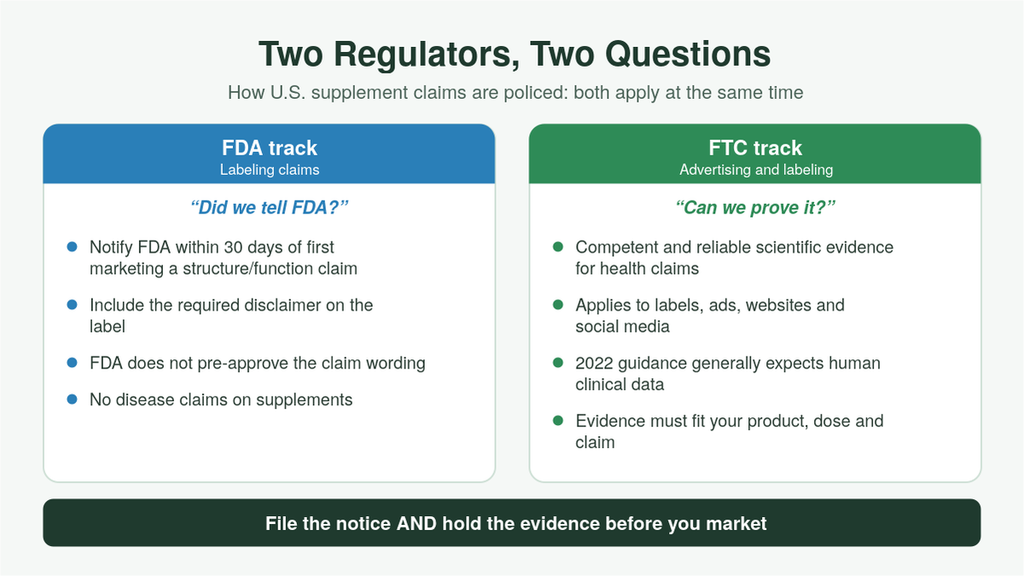
Two federal agencies police supplement claims, and compliance with one does not satisfy the other.
FDA: labeling and notification
FDA regulates supplement labeling. A company using a structure/function claim must have substantiation, notify FDA within 30 days of first marketing the product, and include the mandatory disclaimer. FDA does not pre-approve these claims, but they can attract regulatory attention if they are poorly phrased or inadequately supported.
FTC: advertising and the evidence standard
The FTC polices advertising and expects “competent and reliable scientific evidence” for health-related claims. The FTC’s Health Products Compliance Guidance, issued in December 2022, replaced its 1998 Dietary Supplements advertising guide. The FTC applies the same substantiation standard to any health-related claim, regardless of whether FDA would see it as a health claim, a structure/function claim or a drug claim.
The 2022 guidance says that, as a general matter, substantiation of health benefits will need to be in the form of randomized, controlled human clinical trials. Legal commentators note that the courts have not accepted a rigid rule that only randomized trials can qualify. Federal courts have rejected the narrow position that competent and reliable scientific evidence can mean only randomized controlled trials, and what counts is assessed by scientific experts in context. In practice, plan for human clinical evidence and treat anything less as a risk you must be able to defend.
What counts as “competent and reliable scientific evidence”?
The FTC describes competent and reliable scientific evidence as tests, analyses, research or studies that have been conducted and evaluated objectively by qualified persons and are generally accepted in the profession to yield accurate and reliable results. The agency has said there is no set protocol that satisfies the standard, and that what is enough depends on the claim.
FDA’s substantiation guidance recommends that firms assess the meaning of the claim, how the evidence relates to that claim, the quality of the evidence, and the totality of the evidence. In practice, evidence reviewers look at the following:
- Study design. Randomized, controlled human trials carry the most weight. Observational data, animal studies and in-vitro work are better treated as supporting background.
- Relevance of the endpoint. The outcome measured should match what the claim says. A study of a blood marker does not automatically support a claim about how people feel or perform.
- Population and conditions. Results in a specific group, such as older adults or athletes, support claims for that group.
- Totality of evidence. Selecting only favorable studies is a weakness. A balanced file addresses studies with null or mixed results.
- Independence and quality. Study size, duration, funding and replication all affect how persuasive the evidence is.
Anecdotal material does not count. Testimonials from customers or even doctors are not considered competent and reliable evidence to support a health claim on a supplement label.
If the evidence is weaker than the claim you want to make, narrow the claim. The FTC’s guidance also says that a health-related claim made without competent and reliable scientific evidence must clearly communicate the lack of scientific evidence, which is rarely a commercially attractive option.
Matching evidence to your actual product
The most common substantiation gap is not a lack of science. It is a mismatch between the science and the product. Evidence is only useful if it fits your product, and certified testing laboratories stress that substantiation needs evidence that matches your product’s dosage and formula.
Check each of the following before relying on a study:
- Same ingredient. The studied ingredient should have the same chemical identity, source, extract type and specification as the one in your product. Evidence on one form does not automatically transfer to another.
- Same dose. If the trial used 1,000 mg daily and your serving delivers 250 mg, the study does not support the claim at your dose.
- Same delivery form. Bioavailability can differ between capsules, powders, gummies and liquids, so the studied form should be comparable.
- Same duration and regimen. If benefits appeared after twelve weeks of daily use, say so, and do not imply immediate effects.
- Same population. The study group should resemble your intended consumer.
- Combination products. If the formula combines several ingredients, evidence on each ingredient alone may not support a claim about the blend.
This is also where manufacturing and substantiation meet. If your formula is reformulated, dosed differently or changed to another form, revisit the claims file. An ingredient swap can quietly break the link between your claim and your evidence.
How to build a claims substantiation file
- List every claim. Gather claims from labels, websites, marketplaces, decks, social posts and influencer briefs. Include implied claims.
- Classify each claim. Decide whether it is a nutrient content, structure/function, health or disease claim. Remove or rewrite anything that reads as a disease claim.
- Define the evidence needed. Write down what outcome, dose, population and duration the claim implies.
- Collect and appraise the studies. Prioritize human clinical studies on the same ingredient and dose. Record design, size, endpoints, results and limitations.
- Document the logic. Write a short rationale linking evidence to the claim wording, noting gaps and mixed findings.
- Verify the product. Confirm through testing that the finished product contains the ingredients and amounts stated, so the label matches the evidence.
- Get expert review. Have a qualified scientist or regulatory specialist review the file, and legal counsel review high-risk claims.
- File the notification and finalize the label. Submit the FDA notification within 30 days of first marketing and include the disclaimer.
- Schedule re-reviews. Update the file when new research appears, when the formula changes, or when regulators issue new guidance.
Testing and label compliance
Substantiation covers what a product does. Label compliance covers what the product is. Both rely on testing, and Part 111 requires manufacturers to establish specifications and verify that finished batches meet them. Tests used for this purpose must be scientifically valid.
- Identity and strength. Confirm that the key ingredients are present at the amounts on the label, ideally through the full shelf life. A claim built on a clinical dose is only as credible as the dose in the bottle.
- Contaminants. Heavy metals, microbial limits and other relevant contaminants are part of product specifications.
- Allergens and label statements. Verify that allergen statements, Supplement Facts values and ingredient declarations match the formula.
- Stability. If an expiration date is on the label, it should be supported by stability data, because a claimed dose needs to hold until then.
Brands that outsource production should confirm in advance who owns each step: the brand typically holds the claims file, while the manufacturer holds the specifications, test data and batch records. Agreeing on this early avoids last-minute gaps when a retailer or regulator asks for documentation.
Claims across markets
A claim that is acceptable in the United States may not be acceptable elsewhere. The EU, for example, has its own system for health claims, and even common marketing terms can be restricted. In the EU, the term “probiotic” is effectively treated as a proxy for a health claim, and because no probiotic health claims are authorized there, the term is prohibited in most member states. If you plan to sell in multiple regions, build a region-specific claims map instead of translating one label.
Common claim substantiation mistakes
- Citing studies on a different ingredient or dose. The most frequent error, and the easiest for a challenger to spot.
- Using only favorable studies. Ignoring null results weakens the file.
- Relying on testimonials or traditional use alone. Neither replaces scientific evidence for a health claim.
- Implying disease treatment. Product names, imagery and customer reviews can create implied claims.
- Letting the file go stale. Formulas, studies and guidance change.
- Forgetting marketing channels. Social posts and influencer content are claims too.
- Skipping the FDA notification or disclaimer. Both are routine but easy to miss.
Questions to ask your manufacturing partner
- Can you provide certificates of analysis and finished-batch test results that confirm label amounts?
- Do your specifications match the ingredient specifications used in the supporting studies?
- How do you verify identity and strength of key actives, and with which validated methods?
- What stability data do you hold for similar formats and packaging?
- How do you manage change control when ingredients, suppliers or processes change?
- Can you support documentation requests from retailers and auditors?
Frequently asked questions
What is claim substantiation for supplements?
It is the evidence a company must hold, before making a claim, to show the claim is truthful and not misleading. The FTC’s standard is competent and reliable scientific evidence.
Does FDA approve supplement claims?
No. FDA does not pre-approve structure/function claims. Companies must have substantiation, notify FDA within 30 days of first marketing the product and include the required disclaimer.
Do I need a clinical trial to make a structure/function claim?
The FTC’s 2022 guidance generally points to randomized, controlled human clinical trials, while courts have not accepted a rule limiting evidence to randomized trials. Plan for human clinical evidence and keep claims within what it shows.
Can I use studies on an ingredient if my dose is lower?
Generally not for the same claim. Evidence should fit your ingredient, dose, form and intended population, or the claim should be narrowed.
What is the difference between a structure/function claim and a disease claim?
Structure/function claims describe support for normal body structure or function. Disease claims state or imply that a product treats, prevents, cures or diagnoses a disease, which supplements may not do.
Who is responsible for claim substantiation, the brand or the manufacturer?
Typically the brand that markets the product holds the claims file, while the manufacturer supplies specifications, testing and batch records. Confirm responsibilities in your quality agreement.
Conclusion
Strong claims start before the label is designed. Choose ingredients and doses with human evidence, keep wording on the structure/function side of the line, document the logic, and verify through testing that the finished product matches the science. Brands and manufacturers that treat substantiation as a shared, ongoing process can launch faster, defend their marketing and protect the product when scrutiny arrives.