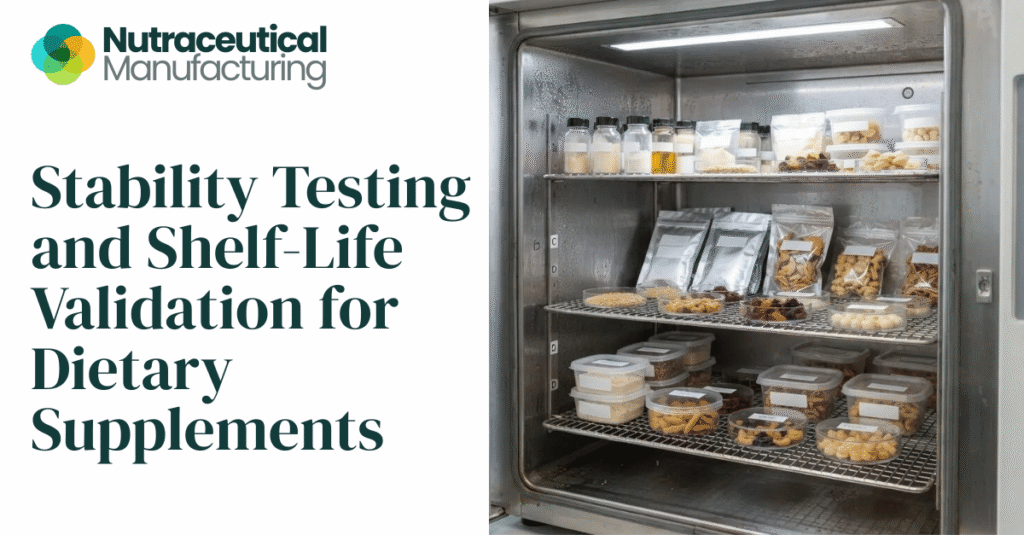
Supplement stability testing is the process of storing a finished product under defined conditions and measuring it over time to confirm that it stays within its specifications for the full shelf life. The result is the evidence behind an expiration or “best by” date, the storage instructions on the label and the confidence that the amount of each active ingredient printed on the label is still there when the consumer opens the bottle.
For brands and manufacturers, stability is where formulation, packaging and quality systems meet. A formula can look perfect at release and still fail at month 14 because moisture entered through the closure, an active oxidized or live cultures died off. This guide covers what U.S. regulations expect, how stability studies are designed, which parameters to test, how packaging and dosage form change the picture, and how to evaluate a partner’s stability capabilities.
What is shelf-life validation for dietary supplements?
Shelf life is the period during which a product, stored in its marketed container under the recommended conditions, still meets its established physical, chemical and microbiological specifications. The ASEAN guidelines on stability for health supplements define it in just these terms: the finished product in its container closure system under the recommended storage condition.
Shelf-life validation is the documented process of establishing and confirming that period. It involves a written protocol, stability-indicating test methods, testing at planned time points, and a decision on the expiration date based on the data.
What does FDA require for supplement stability and expiration dating?
The U.S. position is more nuanced than many brands assume. Four points are worth knowing:
- Expiration dates are not mandatory. Supplements are regulated under DSHEA, which does not mandate expiration dating, so supplements are not required by law to carry one.
- Part 111 does not spell out a stability program. A summary of key differences between drug and supplement GMPs notes that Part 111 contains no explicit requirement for expiration dating, shelf life or associated stability testing, and that FDA declined to provide detailed stability guidance. The rule’s preamble states that if you use an expiration date, you should have data to support it and a written testing program to assess stability characteristics.
- FDA still expects data behind any date. Industry experts report that FDA officials have made clear that if expiration dates are used, adequate stability data is expected and will be looked at during inspections.
- Enforcement has been uneven. One review of FDA warning letters observed that shelf-life and expiration dating were noted as observations rather than formal violations, suggesting the agency treats it as an expectation rather than an explicit requirement.
The practical conclusion is simple. If your label carries a date, treat stability data as mandatory in practice. A date without data is a claim you cannot defend, and a claimed dose that is no longer present at expiry creates labeling and consumer-protection risk. Industry experts note that if a company states an expiration date, the ingredients must stay at label claim levels until then.
Voluntary guidance exists. NSF International helped create a voluntary stability testing guideline for supplements bearing expiration dates, which also proposes that testing be done in the same container used for marketing the product.
Types of stability studies
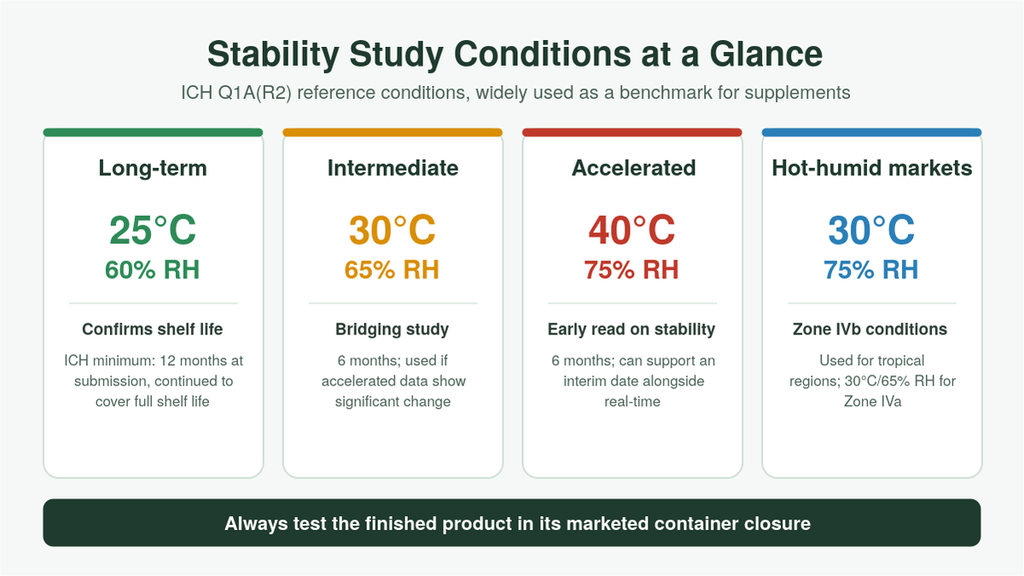
| Study type | Typical conditions (ICH reference) | Purpose |
|---|---|---|
| Long-term (real-time) | 25°C / 60% RH | Establishes and confirms the shelf life under recommended storage |
| Intermediate | 30°C / 65% RH | Bridges accelerated and long-term data when accelerated results show significant change |
| Accelerated | 40°C / 75% RH for 6 months | Gives an early read and can support an interim date, to be confirmed by real-time data |
| Photostability | Controlled light exposure | Checks whether light degrades the product or packaging |
These conditions come from ICH Q1A(R2), the guideline for drug substances and products. ICH issues guidance, not regulations, and supplements are not legally bound to it, but its conditions are widely used as a benchmark in supplement stability programs. Under ICH Q1A(R2), the long-term, intermediate and accelerated conditions are 25°C/60% RH, 30°C/65% RH and 40°C/75% RH, with a minimum of 12 months of long-term data at the time of initial submission and ongoing testing to cover the full proposed shelf life.
Real-time vs. accelerated: use both
Real-time studies are the most direct evidence, but they take as long as the shelf life you want to claim. Accelerated studies give an early read and can help project an initial expiration date, but that projection must be confirmed by a concurrent real-time study. The sensible approach for most launches is to run both in parallel: use accelerated data to support a conservative interim date, then extend it as real-time data accumulate.
Accelerated-only programs are a common weakness. Stress conditions do not always predict real-world behavior, especially for biological products such as probiotics, and accelerated data alone rarely satisfy an inspector or a retailer’s quality team.
Climate and market conditions
Where the product will be sold affects the right conditions. Hot, humid regions use more demanding long-term conditions. Zone IVa markets, which include much of India, use 30°C/65% RH, and Zone IVb tropical regions such as much of Southeast Asia use 30°C/75% RH. Some companies choose 30°C/75% RH for all their long-term studies, so a single study can support all markets. ASEAN also publishes its own stability guidance for health supplements covering batch selection, test parameters, frequency and container closure systems. If you plan to export, confirm the target market’s expectations before you set the protocol.
How to design a supplement stability study
1. Write a protocol
A written protocol should cover the product being tested, the number of batches and sample sizes, specific tests with acceptance criteria, validated test methods, storage conditions and time points, and a description of the container and closure system. Define in advance what happens when a result falls outside specification.
2. Choose the right samples
For initial studies, use samples from at least three batches made with the same formulation and process as commercial product. Use the final, market-ready container closure system, and test the smallest container size, since it is often the most susceptible to environmental factors.
3. Establish time zero
Before storage begins, test all planned parameters on initial samples to create a baseline for critical attributes such as potency, color, appearance and odor, and liquid-specific properties such as viscosity and pH.
4. Pull samples at planned time points
Common long-term time points are 0, 3, 6, 9, 12, 18, 24 and 36 months, although bracketing and matrixing designs can reduce the number of time points when scientifically justified. Focus each interim time point on the parameters most likely to change, and run the full panel at the beginning and the end.
5. Evaluate and decide
Assess trends, not just pass/fail results. Set the expiration date at a point supported by the data, and be conservative if data are limited. Document the rationale, including any out-of-specification results and the investigation.
What to test: a practical stability panel
The parameters depend on the product type and the failure modes that matter for that product. A typical panel for supplements includes:
- Potency of key actives. Assay of the main ingredients against label claim, using stability-indicating methods. Under Part 111, tests used to determine whether specifications are met must be scientifically valid.
- Moisture or water activity. Rising moisture is a fast route to both chemical degradation and microbial growth, and it is often driven by packaging performance rather than the formula.
- Microbial limits. Test for total plate count, yeast and mold, and relevant pathogens, even for dry products, because moisture can change risk over time.
- Appearance, color, odor and taste. Physical changes often show up before assay changes, and consumers notice them first.
- Physical performance. Disintegration or dissolution for capsules and tablets, hardness or texture for tablets and gummies, caking and flow for powders.
- pH and viscosity for liquids and shots.
- Oxidation markers for oils and softgels.
- Viable count for probiotics, where the count at the end of shelf life is what matters.
Stability considerations by dosage form
The same protocol does not fit every product. Pay particular attention to the following:
- Probiotics. Because probiotics must be alive to work and can die during storage, the NIH advises that labels state CFU through the end of shelf life rather than at manufacture. Moisture, heat and oxygen are the main threats, and overages should be based on real stability data.
- Softgels and oils. Oxidation and shell integrity are the main concerns. Peroxide values and packaging with low oxygen transmission are common controls.
- Gummies. Moisture migration, texture change and active degradation after cooking are the main risks, and water activity monitoring is valuable.
- Powders and stick packs. Caking, clumping, flavor fade and moisture uptake need to be tracked, along with actives sensitive to humidity such as vitamin C.
- Botanicals. Track marker compounds that represent the active profile, since a single marker may not reflect the whole extract.
- Liquids and shots. Preservative effectiveness, microbial stability, pH drift, sedimentation and light sensitivity.
Packaging and container-closure systems
Stability is a property of the formulation in its package, not of the formulation alone. The container closure system affects moisture ingress, oxygen exposure and light exposure, so tests should be run on the product as packaged for sale. Bulk testing is not enough, and a mid-lifecycle packaging change, such as a new bottle, liner or desiccant, can invalidate earlier data and calls for reassessment.
Packaging choices commonly evaluated in stability programs include HDPE or PET bottles with or without desiccants, induction seals, alu-alu blisters, sachets and stick-pack films, and amber or opaque containers for light-sensitive products. See our guide on packaging compatibility for how barrier properties interact with different formulations.
Overages, label claim and expiration dates
Because some actives degrade over time, manufacturers sometimes add an overage, which is an amount above label claim at manufacture, so that the product still meets label claim at expiry. Overages should be justified by stability data and should not be used to mask poor process control. Keep in mind that adding excessive amounts of some ingredients can have safety or regulatory implications.
Record the rationale for the chosen expiration date, including the data, trending analysis and any statistical approach used. Whatever date you print, make sure that your label storage statement, such as “store in a cool, dry place,” matches the conditions under which the stability data were generated.
Ongoing stability and records
A stability program does not end at launch. Many companies continue to place commercial batches on stability at intervals to confirm that production remains consistent, and re-evaluate when formulas, suppliers, processes or packaging change.
Related Part 111 requirements include reserve samples. Manufacturers must collect and hold reserve samples of each lot of packaged and labeled dietary supplements that they distribute, and retain them for one year past the shelf-life date, if shelf-life dating is used, or two years from the date of distribution of the last batch associated with the sample. Stability protocols, raw data and reports should be kept under your Part 111 recordkeeping procedures.
Common stability testing mistakes
- Relying on accelerated data alone to justify a long shelf life.
- Testing bulk product instead of the finished product in its marketed container.
- Under-testing actives, such as checking one vitamin and ignoring botanicals or probiotics that degrade faster.
- Skipping microbial and moisture checks on the assumption that dry powders are stable.
- Using only one batch and applying the result to all future production.
- Changing packaging or formula without reassessing stability.
- Testing only at time zero, which says nothing about the product at month 18.
- Using non-validated methods, which can make results unreliable.
How to evaluate a manufacturer’s stability capabilities
Ask potential manufacturing partners:
- Do you design stability protocols, or does the brand supply them?
- Which conditions and chambers do you use, and are they calibrated and monitored?
- Which analytical methods do you use, and are they validated as stability-indicating?
- Is testing done in-house or at an accredited external laboratory?
- What stability data do you hold for similar formats and packaging?
- How do you handle out-of-specification results found during a stability study?
- How are expiration dates assigned, reviewed and extended?
- How do you manage change control when materials or packaging change?
A supplement stability checklist
- Decide whether the product will carry an expiration date, and plan stability accordingly.
- Write a protocol with acceptance criteria and validated methods.
- Test at least three batches in the final container closure system.
- Run accelerated and real-time studies in parallel.
- Choose conditions that reflect your target markets.
- Cover potency, moisture, microbial, physical and sensory attributes.
- Set an overage only with data to support it.
- Match label storage statements to the tested conditions.
- Reassess after any change in formula, process or packaging.
- Keep reserve samples and records for the required period.
Frequently asked questions
Does FDA require expiration dates on dietary supplements?
No. Supplements are not required by law to carry an expiration date. If you choose to include one, FDA expects stability data to support it.
How long does a supplement stability study take?
Real-time studies run for the full shelf life you want to claim, often one to three years. Accelerated studies typically run six months and can support an interim date while real-time testing continues.
Do supplements have to follow ICH stability guidelines?
No. ICH Q1A(R2) is a drug guideline and is not binding for supplements, but its conditions of 25°C/60% RH, 30°C/65% RH and 40°C/75% RH are widely used as a benchmark.
How many batches should be used in a stability study?
For initial studies, use at least three batches made with the commercial formulation and process, in the final market-ready packaging.
Why does packaging matter for stability?
The container closure system controls moisture, oxygen and light exposure. Stability data apply only to the product in the package that was tested.
What is the shelf life of a probiotic supplement?
It depends on the strain, formulation and packaging. Labels should state viable counts through the end of shelf life, supported by stability data.
Conclusion
Stability testing turns a shelf-life claim from an assumption into evidence. Even though U.S. rules do not require a specific stability protocol for supplements, any date printed on a label should be backed by data from the finished product in its marketed package. Brands that plan stability early, test the right parameters, choose conditions for their markets and keep the data current protect label claims, retailer relationships and consumers alike.