
This nutraceutical manufacturing guide explains how nutraceuticals are made, from formulation to final release, which US rules govern production, and how large the market is in 2026. It also covers the developments reshaping the field this year: FDA’s review of what counts as a dietary ingredient, a proposed rule on mandatory GRAS notification, and new production technologies such as precision fermentation.
What Is Nutraceutical Manufacturing?
Nutraceutical manufacturing is the development, production, testing, packaging and release of products that deliver bioactive ingredients, such as vitamins, minerals, herbal extracts, amino acids, probiotics and omega-3 fatty acids, for health benefits beyond basic nutrition. The term nutraceutical was introduced by Stephen DeFelice in 1989 and combines the words nutrition and pharmaceutical, reflecting products that bridge food and medicine.
Nutraceuticals come in many formats, including capsules, softgels, tablets, gummies, powders, functional beverages and fortified foods. Common examples include omega-3s, probiotics and antioxidants. These products are widely used to support overall health; consultation with a healthcare professional is recommended before use.
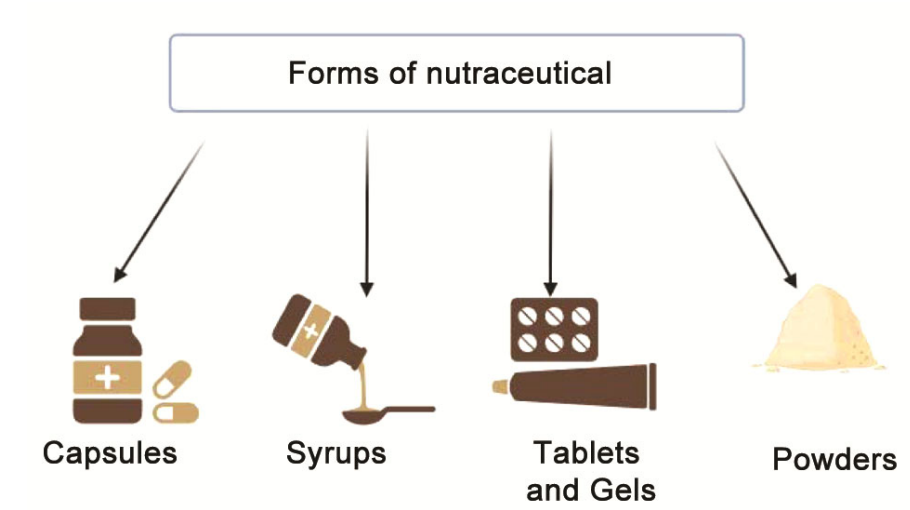
A regulatory note that shapes manufacturing: “nutraceutical” is not a recognized legal category in the United States. Depending on formulation, intended use and claims, a product may be regulated as a food, a dietary supplement, a drug or another category, and the definition itself is debated in the scientific literature. Most nutraceutical capsules, tablets and gummies are sold as dietary supplements, which is why this guide focuses on the supplement rules.
Diverse Applications: Exploring the Types of Nutraceuticals
Nutraceuticals are available in various formats designed to support different health and wellness needs. Understanding these product categories helps businesses identify the right format for their target audience, product concept, and manufacturing requirements.
- Dietary Supplements
- Examples: Vitamins, minerals, herbal extracts, capsules, and powders.
- Focus: Supporting nutritional intake and addressing nutrient deficiencies.
- Functional Foods and Beverages
- Examples: Probiotic foods, fortified snacks, and omega-3-enriched products.
- Focus: Delivering additional nutritional benefits beyond basic nourishment.
- Nutraceutical Skincare
- Examples: Topical creams, lotions, and serums containing botanical extracts and other functional ingredients.
- Focus: Supporting skin health through specialized topical formulations.
- Functional Drinks
- Examples: Energy drinks, functional teas, and plant-based beverages containing vitamins, minerals, or other functional ingredients.
- Focus: Offering convenient, easy-to-consume options for targeted wellness needs.
How Are Nutraceuticals Manufactured? The Process, Step by Step
The exact sequence varies by dosage form and facility, but most nutraceutical production follows nine stages. Figure 1 maps each stage to the part of 21 CFR Part 111 that governs it. Part 111 is organized into subparts covering personnel, plant and grounds, equipment, production and process controls, quality control, components, master and batch records, laboratory operations, manufacturing operations, packaging and labeling, holding and distribution, returned products, complaints and recordkeeping.
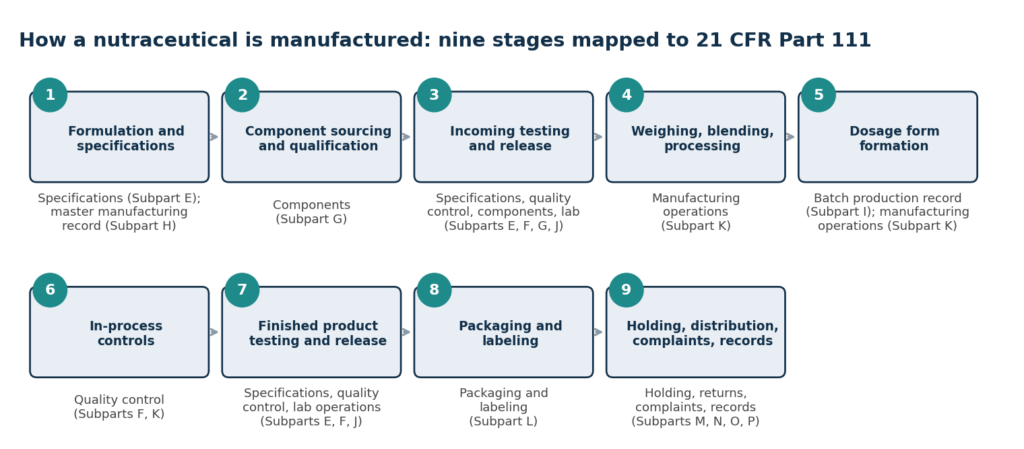
Figure 1. Nutraceutical manufacturing process mapped to 21 CFR Part 111. Source: 21 CFR Part 111 structure (eCFR/Cornell LII).
1. Formulation and specifications
Development starts with the active ingredients, dose, delivery format and excipients. Formulators evaluate ingredient compatibility, dosage feasibility and manufacturing constraints, and many also assess bioavailability and stability. Part 111 requires a written master manufacturing record for each unique formulation of dietary supplement and for each batch size, to ensure uniformity from batch to batch
2. Component sourcing and qualification
Manufacturers source vitamins, minerals, botanical extracts, amino acids, flavors and excipients from approved suppliers and typically require a certificate of analysis for each lot. Qualified-supplier programs and full traceability from raw material to finished product are baseline expectations in well-run facilities
3. Incoming testing and release
Before use, materials are tested against specifications. Typical tests include identity, microbial limits, heavy metals and potency. Under 21 CFR 111.75, manufacturers must conduct at least one appropriate test or examination to verify the identity of each component that is a dietary ingredient, unless FDA grants an exemption petition. A supplier’s certificate of analysis can be relied on for other specifications of components that are not dietary ingredients, but only after the supplier is qualified, and it does not replace identity testing of dietary ingredients
4. Weighing, blending and processing
Ingredients are weighed and combined. For powders, blend uniformity is critical so that each serving contains the labeled amount; ribbon, V and tumble blenders are common. Gummy bases are cooked, and liquids are mixed in sanitary tanks
5. Dosage form formation
The blend or base is converted into its final form. Each format needs different equipment and carries different technical risks:
| Dosage form | How it is typically made | Common technical watch-points |
|---|---|---|
| Capsules | Powder blend filled into hard shells on encapsulation machines, then inspected and polished | Powder flow, fill-weight consistency |
| Tablets | Blend compressed on tablet presses; some tablets are coated | Hardness, disintegration, coating uniformity |
| Softgels | Liquid or semi-solid fill encapsulated in a gelatin or plant-based shell on specialized equipment | Fill compatibility with the shell, shell stability |
| Gummies | Base cooked, molded, dried and coated | Texture, moisture, shelf life |
| Powders and stick packs | Blended powder filled into containers, pouches or stick packs | Blend uniformity, caking |
| Liquids and beverages | Blended in sanitary mixing tanks and filled into bottles | Microbial control, stability |
6. In-process controls
During production, operators check fill weight, tablet hardness, blend uniformity and environmental conditions. Results are recorded in the batch production record, which § 111.255 requires every time a batch is manufactured and which must accurately follow the master manufacturing record
7. Finished product testing and release
Finished product is tested for potency, microbial limits and contaminants such as heavy metals, then reviewed against specifications before quality control personnel release it. Part 111 also sets requirements for collecting and holding reserve samples of dietary supplements
8. Packaging and labeling
Product is packaged and labeled, with lot coding so every unit can be traced to its batch. Label review should cover the supplement facts panel, serving size and claims language for the destination market
9. Holding, distribution, complaints and records
The final stage covers storage, distribution, handling of returned product and product complaints, and retention of records. These are separate subparts of Part 111, which is why inspectors and auditors review complaint files and batch records as closely as the production floor
Quality Control and Certification in Nutraceutical Manufacturing
What quality control covers
Quality control runs through the whole process rather than sitting at the end. It includes verifying incoming materials, checking critical parameters during production, testing finished product against specifications, and keeping records that let a manufacturer trace any unit back to its ingredients and batch. Stability studies, which assess how a formulation holds up over its intended shelf life, are a standard part of product development.
Third-party GMP certification
NSF/ANSI 455-2 is a GMP certification standard for dietary supplement facilities involved in manufacturing, packaging, and warehousing and distribution. Other credentials commonly seen on the market include NSF Certified for Sport, the USP Verified Mark, Informed Sport and ISO 22000 for functional food manufacturing. A certificate is only as useful as its scope and date, so check what the certification covers and verify it against the issuing body’s registry rather than relying on self-reported claims.
Latest Nutraceutical News-
- Dyadic Targets 200 Metric Tons in Alpha-Lactalbumin Deal

- Biofarma Group Takes 70% Stake in EuroPharma Alliance

- Solabia Takes Majority Stake in Ethical Naturals

- Conch Lifescience Raises Tablet Capacity to 300,000

- AstaReal Extends EB15 Astaxanthin to Human Supplements
- Catalent Names Wetteny Joseph to Lead Pharma and Consumer Health

Nutraceutical Manufacturing Market Size and Growth (2026)
Global nutraceuticals market: why estimates disagree
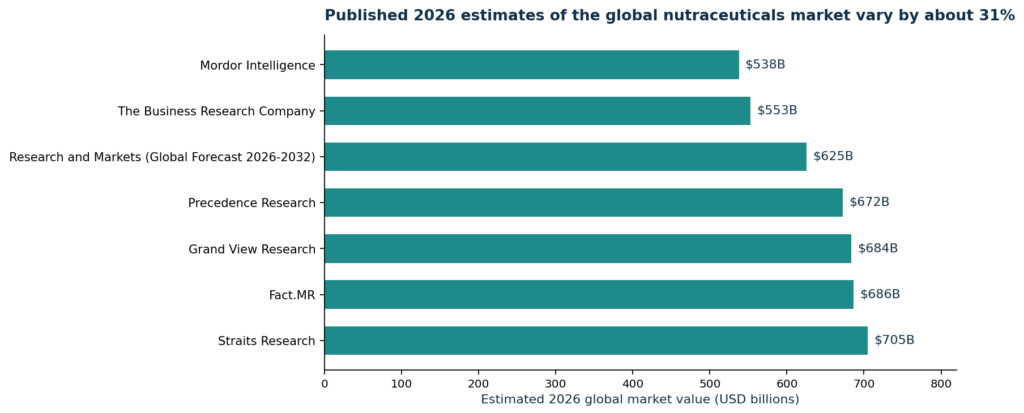
Figure 3. Estimated 2026 global nutraceuticals market by publisher. Sources: Mordor Intelligence, The Business Research Company, Research and Markets, Precedence Research, Grand View Research, Fact.MR, Straits Research.
Growth drivers
- Aging population and preventive health: rising demand for supplements aimed at long-term health
- Post-pandemic health focus: sustained spending on immunity, gut health and mental wellness products
- E-commerce expansion: online is the fastest-growing US channel per NBJ, lowering barriers to launching a brand
- Format and ingredient innovation: gummies, effervescents and liquids, plus novel botanicals, fermentation-derived actives and microbiome-focused formulas, require specialized production expertise
Growth inhibitors
- Raw material volatility: price swings for omega-3s, adaptogens and botanicals affect margins
- Regulatory uncertainty: the open questions on dietary ingredient scope and GRAS notification, plus differing rules across markets, complicate product development and multi-region launches
- Quality and compliance risk: cGMP violations and regulatory warnings show that standards vary between facilities
Nutraceutical Manufacturing Regulations in 2026
The US baseline: DSHEA and 21 CFR Part 111
In the US, nutraceuticals sold as dietary supplements fall under the Dietary Supplement Health and Education Act (DSHEA) of 1994. Under DSHEA, FDA does not have the authority to approve dietary supplements before they are marketed, so the firms that make and sell them carry primary responsibility for safety, quality and accurate labeling (see FDA’s dietary supplement Q&A). Current good manufacturing practice for supplements is set out in 21 CFR Part 111 (current text also on eCFR); FDA also publishes a plain-language small entity compliance guide to the rule. Facilities that manufacture, process, pack or hold dietary supplements for consumption in the United States must also register with FDA.
Responsibility follows the product name. FDA warning letters, quoted in trade coverage from 2013 and again in 2026, state that a firm placing a supplement into commerce has an “overarching and ultimate responsibility” for cGMP compliance in all phases of production, even when others perform some operations.
2026 development: FDA reopens the dietary ingredient question
On March 27, 2026, FDA’s Office of Dietary Supplement Programs held a public meeting on the scope of dietary supplement ingredients. The agenda covered the meaning of “dietary substance” in DSHEA, new methods of producing existing dietary ingredients, and ingredient types such as proteins, enzymes and microbials. Comments closed April 27, 2026 on docket FDA-2026-N-2047, and FDA said it would review input to determine next steps.
One of the questions FDA put to stakeholders is directly relevant to manufacturing. As summarized by law firm Epstein Becker Green, FDA asked at what point a change in production methodology meaningfully alters an existing ingredient’s identity, composition or safety profile and therefore warrants additional scrutiny or data submission. Law firm Alston & Bird likewise reports the agency is assessing when manufacturing changes may trigger new regulatory scrutiny or new dietary ingredient submissions.
What it means for manufacturers and brand owners: no new rule has been issued, so nothing has changed legally. But a company moving an ingredient to a new production method, for example from plant extraction to fermentation, should expect questions about identity and safety data, and should keep process changes and their supporting documentation well controlled.
2026 development: proposed mandatory GRAS notification
On August 11, 2026, FDA published a proposed rule (91 Fed. Reg. 51834) that would replace the current voluntary GRAS notification program with a mandatory one for human and animal food substances. Under the proposal, the mandatory notice requirement would take effect 18 months after the effective date of any final rule. Law firm Sidley Austin notes the proposal creates uncertainty for supplement companies that have relied on self-affirmed GRAS conclusions as a practical route to market, and that it remains unclear whether FDA can review the expected volume of submissions. Comments are due December 9, 2026, and the rule is not final. For novel ingredients, manufacturers should be able to document the regulatory basis for each one: an NDI notification, a GRAS conclusion or history of use in the food supply.
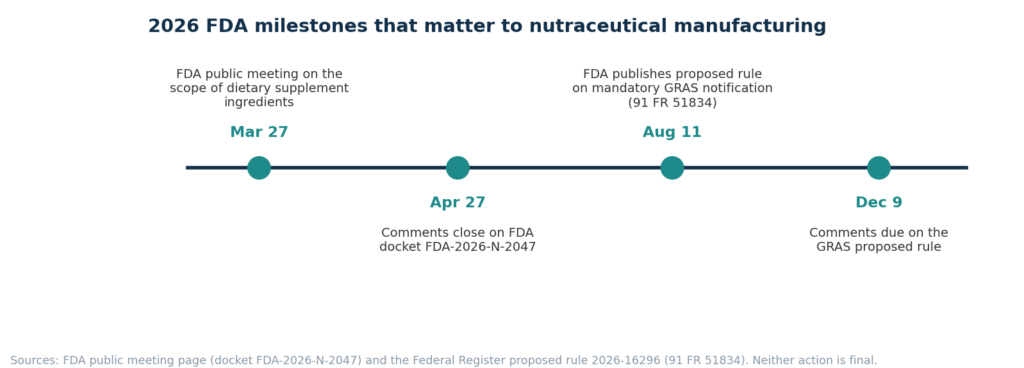
Figure 2. 2026 FDA milestones affecting nutraceutical manufacturing. Sources: FDA; Federal Register; Sidley Austin
Outside the US
In the European Union, nutrition and health claims on food, including food supplements, are governed by Regulation (EC) No 1924/2006. Requirements differ by market, so confirm label and claim rules for each destination before production.
How to Choose the Best Nutraceutical Manufacturing Partner
Choosing the right nutraceutical manufacturing partner requires evaluating quality, compliance, capabilities, and long-term reliability. Key factors include:
- Manufacturing capabilities & scalability
- GMP certification & regulatory compliance
- Formulation & R&D expertise
- Raw material sourcing & quality control
- Private label & custom manufacturing
- Minimum order quantity (MOQ) & flexibility
- Packaging & labeling capabilities
- Export experience & international compliance
- Pricing & long-term value
- Communication & transparency
- Innovation & market trends
- Confidentiality & intellectual property
- Industry reputation & track record
- Facility audits & inspections
- Long-term strategic partnership
Nutraceutical Procurement Strategy and Supply Chain Management
An effective nutraceutical procurement strategy helps manufacturers source quality ingredients, control costs, and keep production running smoothly. A well-managed nutraceutical supply chain strategy ensures raw materials are sourced reliably and meet the required quality and regulatory standards.
Procurement Best Practices
- Supplier Audits: Check suppliers’ quality standards, certifications, and regulatory compliance before partnering with them.
- Vendor Relationships: Build long-term relationships with trusted suppliers to secure better pricing and a consistent supply of ingredients.
- Demand Forecasting: Use data and analytics to plan inventory, avoid shortages, and reduce excess stock.
As businesses focus on procurement transformation, many are adopting AI-powered tools to track inventory, improve demand forecasting, reduce costs, and manage supplier relationships more efficiently.
Strategic Outlook for Nutraceutical Manufacturing Partnerships
Three themes stand out for the rest of 2026 and beyond. First, regulators are asking more questions about how ingredients are made, not only what they are, which raises the value of documented process control. Second, documented GMP controls remain the baseline of quality, and third-party certification is one way to show it. Third, sales channels are shifting toward e-commerce, which is likely to keep pressure on manufacturers to support a wider range of formats. Market estimates differ widely, so any plan should rest on one clearly defined data source.
Frequently Asked Questions About Nutraceutical Manufacturing
What is nutraceutical manufacturing?
Nutraceutical manufacturing is the development, production, testing, packaging and release of products that deliver bioactive ingredients, such as vitamins, herbal extracts, probiotics and omega-3s, for health benefits beyond basic nutrition. In the US, most are made and sold as dietary supplements under FDA’s current good manufacturing practice rules in 21 CFR Part 111.
How are nutraceuticals manufactured?
Production typically moves through formulation, ingredient sourcing and testing, blending, dosage form formation (capsule, tablet, softgel, gummy, powder or liquid), in-process checks, finished product testing and release, then packaging, labeling and distribution. Each stage is documented in master and batch records.
Are nutraceuticals regulated by FDA?
“Nutraceutical” is not a legal category in the US. Products are regulated as foods, dietary supplements or drugs depending on formulation, intended use and claims. Dietary supplements are not approved by FDA before marketing, but manufacturers must follow Part 111, and FDA can act against unsafe or misbranded products.
What does 21 CFR Part 111 require?
Part 111 sets current good manufacturing practice requirements for manufacturing, packaging, labeling and holding dietary supplements. Its subparts cover personnel, plant and grounds, equipment, production and process controls, quality control, components, master and batch records, laboratory operations, holding and distribution, product complaints and recordkeeping.
What dosage forms are used in nutraceutical manufacturing?
Common formats include hard-shell capsules, compressed tablets, softgels, gummies, bulk and single-serve powders, stick packs, effervescents, chewables, liquids and ready-to-drink beverages. Each requires different equipment and controls.
What GMP certifications exist for nutraceutical facilities?
For US production, the legal baseline is 21 CFR Part 111. Third-party credentials include NSF/ANSI 455-2, NSF Certified for Sport, the USP Verified Mark, Informed Sport and ISO 22000. Verify any certificate against the issuing body’s registry.
How big is the nutraceutical market in 2026?
It depends on the definition. Published 2026 estimates of the global nutraceuticals market range from about $538 billion to $705 billion. For US dietary supplements, Nutrition Business Journal reported $72.88 billion in sales for 2025. Always cite one named publisher and its scope.
What regulatory changes could affect nutraceutical manufacturing in 2026?
FDA held a March 27 public meeting on the scope of dietary supplement ingredients, including new production methods such as precision fermentation, and on August 11 it proposed making GRAS notification mandatory, with comments due December 9, 2026. Neither action is final.