
Nutraceutical dosage forms determine far more than how a supplement looks on the shelf. The format chosen for a product affects the dose that can be delivered, ingredient stability, manufacturing process, packaging requirements, consumer experience and, in some cases, how effectively an ingredient can be formulated for its intended use.
The FDA recognizes dietary supplements in many forms in the United States, from tablets, capsules and softgels to gelcaps, liquids, gummies and powders. The strongest choice is therefore not the most fashionable format but the one that fits the product’s formulation, target dose, stability, consumer and commercial requirements.
Why dosage form selection matters commercially
Choosing a dosage form is about more than formulation science. It influences unit cost, lead times and minimum order quantities, and it determines which manufacturers have the right equipment and experience to produce the product at all. The size of the contract manufacturing sector shows how much rides on this decision. Industry estimates value the global nutraceutical contract development and manufacturing market at around USD 35.1 billion in 2024, with growth of roughly 7.9% a year taking it to about USD 55.4 billion by 2030.
Three trends are driving that growth: personalized, function-specific products; stricter regulatory expectations in major markets; and the rapid rise of private-label and direct-to-consumer brands. Each one affects format choice. Targeted multi-ingredient formulas, compliance requirements and quick-to-market launches all favor some dosage forms over others.
What is a nutraceutical dosage form?
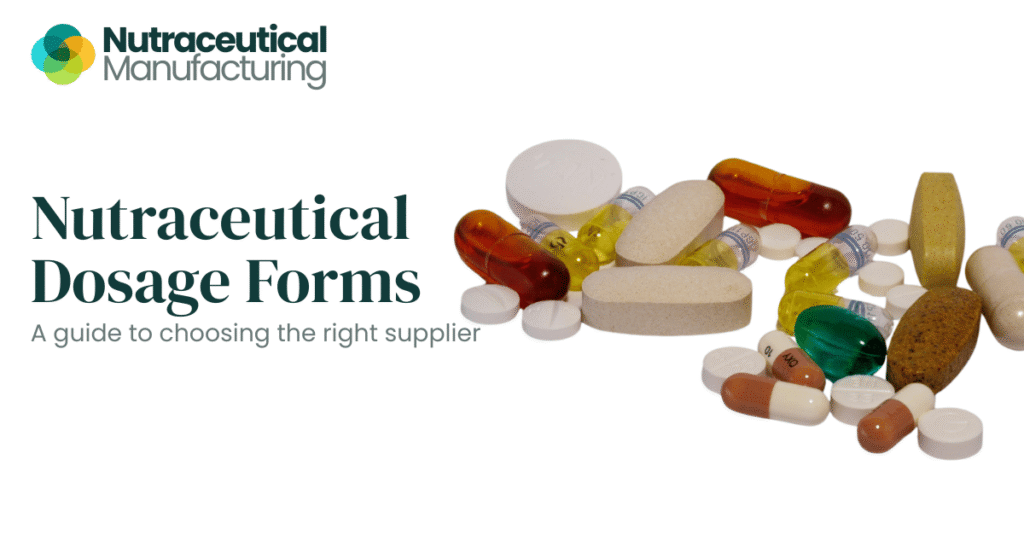
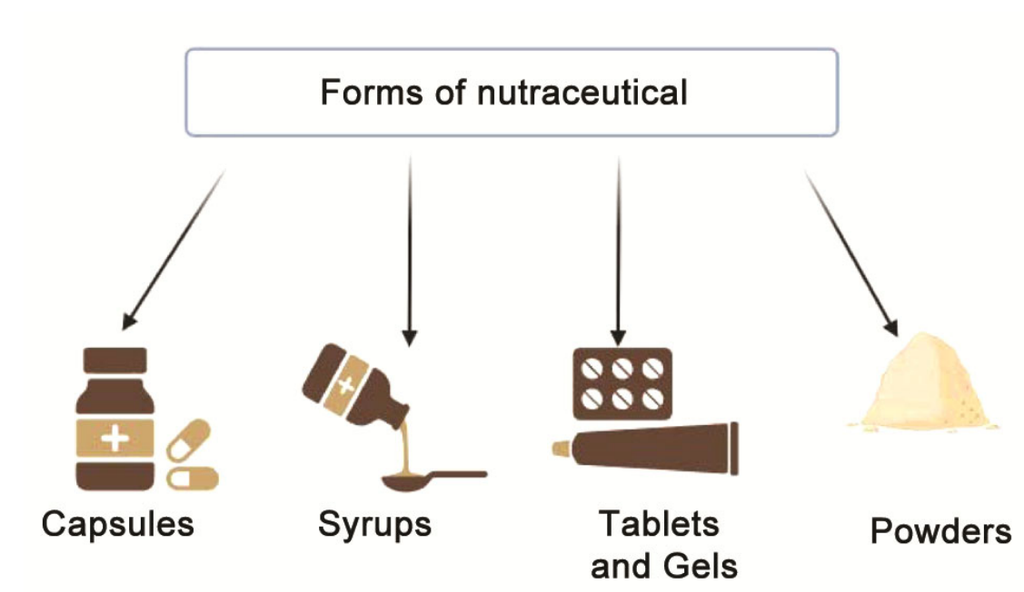
A dosage form is the physical format in which a nutraceutical or dietary supplement is manufactured and consumed. Common examples include tablets, hard-shell capsules, softgels, powders, gummies and liquids. Other formats include chewable tablets, lozenges, stick packs, sachets and bars.
For product developers, dosage-form selection is an early formulation decision because it establishes important constraints. A high-dose mineral formula may be difficult to fit into a small capsule. An oil-based active may be naturally suited to a softgel. A sports-nutrition formula requiring several grams per serving may work better as a powder. A product aimed at consumers who dislike swallowing pills may favour a gummy, chewable or liquid.
The main nutraceutical dosage forms
Tablets
Tablets are produced by compressing a formulated blend into a defined shape and weight. They can accommodate relatively high ingredient loads and are well suited to vitamins, minerals, botanicals and multi-ingredient formulations. Manufacturers can also apply film coatings to improve appearance, swallowing, taste masking or protection from environmental exposure.
Successful tablet production depends on the behaviour of the powder blend during granulation, flow and compression. Ingredients that compress poorly may require binders or other excipients, while excessive tablet size can reduce consumer acceptability. Manufacturers therefore have to balance dose, hardness, disintegration, friability and swallowability rather than simply maximising the amount of active material in each unit.
Hard-shell capsules
Hard capsules typically consist of a two-piece shell filled with powder, granules, pellets or, with suitable technology, some liquid or semi-solid formulations. Gelatine and plant-derived capsule shells are both widely available.
Capsules can be attractive for formulations that do not compress well into tablets and can simplify development for many powdered ingredients. Their capacity is limited by capsule size and bulk density, however, so high-dose formulas may require multiple capsules per serving. Flow characteristics and fill-weight consistency are critical manufacturing considerations.
Softgels
Softgels enclose a liquid or semi-solid fill inside a sealed flexible shell. They are particularly associated with oils and lipophilic ingredients such as fish oils and fat-soluble vitamins. The enclosed format can also help isolate ingredients from air and provide a smooth, easy-to-swallow consumer format.
Softgel development requires compatibility between the fill material and the shell. Water activity, fill composition, oxidation risk and shell formulation all need to be considered. Manufacturing is more specialised than standard powder encapsulation because formation, filling and sealing occur as an integrated process.
Powders
Powders are useful when the required serving is too large for a practical tablet or capsule. Protein products, amino acids, creatine, electrolytes, greens blends and other high-dose formulations commonly use tubs, sachets or stick packs.
Powder development shifts emphasis toward blending uniformity, flow, dispersibility, flavour, mouthfeel and moisture control. When a serving contains ingredients at very different inclusion levels, manufacturers need a blending strategy that achieves content uniformity throughout the batch. Hygroscopic ingredients may also require careful environmental controls and moisture-resistant packaging.
Gummies
Gummies combine supplement actives with a confectionery-style delivery system. Their major advantage is consumer experience: they are easy to take and can create a distinctive flavour, texture and visual identity. But gummies can impose tighter formulation constraints than capsules or tablets.
The active ingredients must remain compatible with the gummy matrix and manufacturing process. Heat exposure, pH, water activity, ingredient taste, potency over shelf life and interactions with gelatine or pectin systems all require evaluation. A gummy also has finite capacity, making very high-dose formulations difficult without increasing serving size.
Liquids
Liquid supplements include solutions, suspensions, emulsions, syrups, shots and drops. They can suit consumers who have difficulty swallowing solid formats and allow flexible serving sizes. Liquids can also be useful when an ingredient is naturally supplied in solution or when a concentrated dose can be delivered in a small volume.
Formulators must address solubility or suspension behaviour, flavour, pH, microbial control, oxidation and physical stability. Multi-dose liquids also introduce packaging and dosing-device considerations. In the U.S., manufacturers should additionally consider FDA guidance distinguishing liquid dietary supplements from conventional beverages.
Other nutraceutical dosage forms worth considering
Beyond the six core formats, several variations give developers more room to match a formula to its consumer.
- Chewable tablets and lozenges: compressed formats designed to be chewed or dissolved in the mouth. They suit consumers who dislike swallowing tablets, but taste masking and texture become central formulation challenges.
- Chewable softgels: a hybrid of softgel and chew. Contract manufacturer Sirio, for example, has reported granted patent applications for chewable softgels designed for mouthfeel and taste, aimed at both adults and children.
- Stick packs and sachets: single-serve powder or granule formats that combine portability with accurate dosing, and avoid the bulk of a tub. They place particular demands on moisture-barrier laminates and filling-line precision.
- Effervescent tablets and powders: dissolve in water to create a drink, which can help consumers who struggle with large solids. They need rigorous humidity control during manufacture and storage because moisture triggers the effervescent reaction prematurely.
- Bars and functional foods: straddle the boundary between supplements and conventional foods, so the regulatory presentation of the product matters as much as the formulation.
- Drops and sprays: concentrated liquids for flexible dosing, often used for vitamin D, probiotics for infants and sublingual products.
How dosage forms compare
|
Dosage form |
Often suited to |
Key manufacturing considerations |
|---|---|---|
|
Tablets |
Vitamins, minerals, botanicals, multi-ingredient formulas |
Compression, hardness, disintegration, coating, friability |
|
Capsules |
Powders, granules and lower-to-moderate dose formulas |
Powder flow, fill weight, shell compatibility, capsule size |
|
Softgels |
Oils, lipid-based ingredients and fat-soluble nutrients |
Fill-shell compatibility, oxidation, sealing and drying |
|
Powders |
High-dose formulas, sports nutrition and drink mixes |
Blend uniformity, flavour, dispersibility, moisture and flow |
|
Gummies |
Consumer-friendly, lower-dose formulations |
Heat, pH, water activity, texture, flavour and potency |
|
Liquids |
Drops, shots, suspensions and easy-to-swallow products |
Solubility, microbial control, flavour, oxidation and packaging |
Latest Nutraceuticals News-
- Dyadic Targets 200 Metric Tons in Alpha-Lactalbumin Deal

- Biofarma Group Takes 70% Stake in EuroPharma Alliance

- Solabia Takes Majority Stake in Ethical Naturals

- Conch Lifescience Raises Tablet Capacity to 300,000

- AstaReal Extends EB15 Astaxanthin to Human Supplements
- Catalent Names Wetteny Joseph to Lead Pharma and Consumer Health

Market Size: where demand is heading
Published market estimates vary considerably between research houses because each defines the category differently, so the figures below are best read as directional rather than definitive.
|
Format |
Indicative market data |
Source |
|---|---|---|
|
Tablets |
Held 35.12% of the dietary supplements market by form in 2024, attributed to convenience, ease of storage and longer shelf life | |
|
Softgels |
Global softgel capsule market of USD 9.3 billion in 2024, forecast to reach USD 18.4 billion by 2034 (CAGR 7.2%); health and dietary supplements accounted for 65.4% of the 2024 market | |
|
Vegetarian softgels |
USD 875.44 million in 2024, forecast to reach USD 1.88 billion by 2032 (CAGR 10.07%) | |
|
Gummies |
Global gummy vitamins market of USD 7.7 billion in 2025, forecast to reach USD 11.1 billion by 2034 (CAGR 4.12%) |
Two observations follow. First, tablets and capsules remain the volume backbone of the category, which is why most manufacturers can quote them quickly and competitively. Second, the fastest-moving growth stories are in specialised formats. Allied Market Research published a higher gummy estimate (USD 9.1 billion in 2022, rising to USD 16.3 billion by 2032), and the vegetarian softgel segment is forecast to grow faster than softgels overall. The softgel figures above also include pharmaceutical applications, so they overstate the nutraceutical-only opportunity.
Excipients, shells and gelling systems
The non-active components of a dosage form often determine whether it can be manufactured at all, and increasingly they determine how the product is positioned.
Tablets – Fillers, binders, disintegrants, glidants and lubricants control compression behaviour, hardness and how quickly the tablet breaks up. Film-coating polymers add taste masking, moisture protection and appearance. Because every excipient adds weight and bulk, formulators have to weigh functionality against the swallowability of the finished tablet.
Capsule shells – Gelatine remains widely used, while plant-derived shells based on materials such as HPMC (hypromellose) serve vegetarian and vegan positioning. Shell choice can influence moisture content, oxygen permeability and compatibility with the fill, so it should be tested rather than assumed to be interchangeable.
Softgel shells – According to Pii’s formulation team, softgel shells are made from a flexible gelatine film plasticised with glycerin, sorbitol or a similar polyol. Global Market Insights notes that plant-based alternatives using potato starch, HPMC and pullulan are boosting industry growth, which reflects growing demand for vegan-friendly formats.
Gummy matrices – Gelatine, pectin and agar-based systems each behave differently in terms of texture, heat tolerance and label positioning. Platforms covering gelatine and non-gelatine gummies including agar and pectin, as well as centre-filled and mixed-matrix designs. Sweetener choice matters too: a Contract Pharma feature points to maltitol and erythritol as viable alternatives to sugar in low-sugar gummies.
Bioavailability and release profile
Dosage form influences how an ingredient is released and, potentially, how well it is absorbed. This does not mean a particular format is automatically more bioavailable; the effect depends on the ingredient, the formulation and the evidence behind it.
- Lipid-based fills. Fat-soluble ingredients may be presented in an oil or semi-solid fill inside a softgel, which is one reason the format is favoured for fish oils, fat-soluble vitamins and some botanical extracts. Pharmaceutical developers use the same logic: Pii notes that a low-solubility active in tablet form may be reformulated as a softgel to reduce the dose and improve bioavailability
- Release timing. Solubility, pH and stability determine whether an ingredient calls for immediate, delayed or sustained release
- Sensitive actives. Probiotics, certain vitamins and polyphenols can degrade with moisture, heat or oxygen. Dry formats with strong barrier packaging, or oil-based fills, are often used to protect them, whereas water-containing formats such as gummies and liquids demand closer stability monitoring
- Evidence. Any bioavailability or efficacy claim should be supported by data on the finished format, not inferred from the ingredient alone
How to choose the right nutraceutical dosage form
1. Start with ingredient properties
The physical and chemical properties of the active ingredients narrow the available options. Developers should assess whether ingredients are powders, oils or liquids; their solubility; bulk density; sensitivity to heat, oxygen, moisture and light; taste; and compatibility with likely excipients and processing conditions.
2. Define the required dose
Dose is one of the strongest practical constraints. A formula requiring several grams per serving is unlikely to fit comfortably into one or two capsules. Conversely, a potent ingredient required at only a few milligrams may need careful dilution and blending to achieve content uniformity.
3. Consider stability and shelf life
Dosage form and packaging work together to protect the formulation. Hygroscopic powders may need strong moisture barriers. Oils may require oxidation control. Light-sensitive ingredients may benefit from opaque or amber packaging. Gummies and liquids need particular attention to water activity, microbiological risk and physical stability.
4. Design for the consumer
Swallowability, flavour, convenience, portability and serving frequency can determine whether a technically successful formulation is commercially successful. A large tablet may achieve the target dose but create a poor user experience. A gummy may improve adherence but force compromises in active load or formulation complexity.
5. Assess manufacturing feasibility
Each dosage form requires different equipment, process controls and technical expertise. Tablet compression, powder encapsulation, softgel production, gummy depositing and liquid filling are distinct manufacturing platforms. Product developers should establish early whether the selected manufacturer has relevant equipment, scale, quality systems and experience with the intended ingredients.
6. Model packaging and logistics
The dosage form influences packaging format, pack size, shipping weight and environmental protection. Bottles, blister packs, sachets, stick packs, jars and liquid containers have different filling lines and barrier properties. Packaging should therefore be considered during formulation development rather than after the formula is finalised.
7. Check the regulatory route
The same ingredient can be treated differently depending on the format, the claims made and the market. A product presented as a food supplement is regulated differently from one presented as a medicine, and some formats, such as bars or shots, sit closer to conventional food. Confirm the intended regulatory status for each target market before locking the format (see the regulatory section below).
Quality and testing considerations
Regardless of dosage form, dietary supplement manufacturing in the U.S. is subject to current good manufacturing practice requirements. The specific in-process controls and finished-product tests vary with the formulation and format, but manufacturers need systems that establish identity, strength, composition, quality and appropriate limits for contaminants.
Dosage form changes the practical testing program. Tablets may require hardness, friability and disintegration testing. Capsules require fill-weight and shell controls. Powders may need close attention to blend uniformity and moisture. Gummies and liquids can require additional physical, microbiological and stability controls because of their higher water activity or complex matrices.
Beyond these form-specific checks, the principles behind pharmaceutical quality systems apply equally to supplements: identity testing, validated analytical methods and documented release criteria. A capable manufacturer should offer HPLC analysis, microbial testing, accelerated stability studies and shelf-life validation.
Regulatory considerations: United States, United Kingdom and European Union
Dosage form and regulatory status are linked. The format, the claims and the way a product is presented all affect whether it is treated as a food supplement, a conventional food or a medicine, so the regulatory route should be confirmed alongside the format. The notes below are a general orientation, not legal advice, and a regulatory specialist should review any product before launch.
United States
Any nutraceutical manufacturer serving the US market must operate under FDA current good manufacturing practice for dietary supplements, set out in 21 CFR Part 111 under DSHEA. Leading facilities frequently add third-party credentials such as NSF/ANSI 455, USP verification, NSF Certified for Sport, Informed Sport or ISO 22000, and buyers should check these against the issuing body’s registry rather than relying on self-reported claims. Labeling for the US market also follows specific rules on the Supplement Facts panel, serving-size declarations and structure/function claims.
United Kingdom
In the UK, the Food Supplements (England) Regulations 2003 implement the EU Food Supplements Directive 2002/46/EC, with equivalent regulations for Scotland, Wales and Northern Ireland. Under these rules a food supplement is a food sold in dose form, intended to supplement the normal diet, that is a concentrated source of a vitamin, mineral or other substance with a nutritional or physiological effect. Supplements must be sold prepacked, must meet compositional requirements for the vitamins and minerals used, and must carry prescribed labelling, including a statement that they should not be used as a substitute for a varied diet. The Regulations do not apply to medicinal products as defined by the Human Medicines Regulations 2012. Official non-statutory guidance notes apply across the UK, although legislation is implemented on a devolved basis and has been amended since the UK left the EU.
European Union and other markets
The EU Food Supplements Directive 2002/46/EC provides the framework for member states, covering permitted vitamin and mineral substances and labelling. Other markets, including Health Canada’s natural health product rules and the Australian TGA framework, each impose distinct requirements. For brands planning multi-region launches, regulatory fragmentation is a genuine constraint, and it can influence format choice. A gummy or liquid that is straightforward in one market may require different positioning, dose limits or ingredient approvals in another.
Trends shaping dosage-form development
- Low-sugar and sugar-free gummies. Sugar content is widely cited as a restraint on gummy growth. A Contract Pharma feature describes a study by Sirio researchers on low-sugar and sugar-free gummies using alternatives such as maltitol and erythritol, reporting that taste and texture can be maintained without sugar.
- Plant-based and vegan formats. The growth of vegetarian softgels and plant-derived capsule shells reflects consumer demand for animal-free products, as shown in the market snapshot above.
- Personalization and functional specificity. Brands are launching more targeted products, such as cognitive health blends, women’s hormonal support stacks and performance nutrition formulas, that require more sophisticated formulation chemistry. These multi-ingredient formulas often push developers toward tablets, powders or multi-compartment formats.
- Capacity investment in gummies and softgels. Manufacturers continue to build dedicated capacity. Sirio, for instance, opened a gummy plant in Ma’anshan, China with an annual capacity of 2.4 billion gummies, while Procaps Group announced plans for a new gummy facility in Florida, its first outside Colombia.
- Sustainability. Brands are increasingly asking about recyclable or post-consumer recycled packaging and waste reduction, and capsule and ingredient suppliers are responding with dedicated sustainability programs.
- Direct-to-consumer and private-label growth. Fast-to-market brands favor formats and partners with low MOQs, branded packaging and quick production cycles.
Dosage form selection checklist
Use the questions below as a quick screen before committing to a format. They are starting points and do not replace formulation trials.
|
Question |
If the answer is yes, consider |
|---|---|
|
Is the active an oil or fat-soluble ingredient? |
Softgel or liquid-filled capsule |
|
Does a serving need several grams of material? |
Powder, sachet or stick pack |
|
Is the formula high-dose, multi-ingredient and cost-sensitive? |
Tablet |
|
Does the blend compress poorly at a moderate dose? |
Hard-shell capsule |
|
Is the target consumer reluctant to swallow pills? |
Gummy, chewable, liquid or stick pack |
|
Is the active sensitive to heat or water? |
Dry format with barrier packaging; gummies and liquids only with supporting stability data |
|
Is vegan or vegetarian positioning required? |
Plant-derived capsule shells, pectin or agar gummies, vegetarian softgels |
|
Is a low MOQ essential at launch? | Capsules and powders, which tend to offer the lowest MOQs |
|
Will the product be sold in several regulatory regions? |
Confirm format and claims for each market before finalising |
Common pitfalls
- Choosing the format for marketing reasons first. Discovering later that the required dose will not fit forces either a larger serving size or a compromised formula.
- Treating shells and matrices as interchangeable. Moving from gelatine to a plant-derived shell, or from gelatine to pectin in a gummy, can change stability, texture and processing conditions.
- Leaving packaging until last. Barrier properties, pack size and filling-line compatibility all depend on the format.
- Skipping accelerated stability work. Water-containing and heat-processed formats in particular need potency checked across shelf life.
- Not verifying validated experience. A manufacturer’s equipment list does not show it can run your format at commercial scale. Ask for batch records or reference products.
- Over-weighting price. Unusually low pricing is a red flag, since it can signal weaker raw-material sourcing, thinner testing protocols or unqualified manufacturing environments.
Dosage form selection when working with a contract manufacturer
A nutraceutical contract manufacturer should be able to explain the trade-offs created by each format rather than simply quote the requested product. Early development discussions should cover target dose, ingredient properties, desired serving size, excipient constraints, flavour requirements, stability risks, packaging and forecast volume.
Manufacturing capability is also important. Some facilities specialise in a small number of formats, while others offer multiple platforms. A manufacturer with direct experience in the intended dosage form can identify scale-up risks, realistic tolerances and packaging requirements before significant time is invested in a formulation that is difficult to commercialise.
Questions to ask a shortlisted manufacturer
- Can you share the outcome of your most recent FDA inspection, along with any third-party GMP audit from the past 18 months?
- How do you qualify raw-material suppliers, and can you show an example qualification package?
- What are your lead times from final formula to finished goods for this dosage form and volume?
- What product recall insurance or liability coverage do you carry, and what happens if a batch fails release testing?
- How much capacity is available for new clients, and how is scheduling prioritized during busy periods?
- Do you have in-house analytical capability, or do you rely entirely on external laboratories for release testing?
Frequently asked questions about nutraceutical dosage forms
What are the most common nutraceutical dosage forms?
The most common forms are tablets, capsules, softgels, powders, gummies and liquids. Dietary supplements can also be sold in other ingestible formats, including bars, lozenges and chewables, provided they meet the applicable regulatory definition and labelling requirements.
Which dosage form is best for nutraceuticals?
There is no universally best form. The right choice depends on ingredient properties, target dose, stability, consumer preferences, manufacturing capability, packaging and cost.
Are capsules better than tablets?
Not inherently. Capsules can be useful for ingredients that are difficult to compress and may offer a preferred consumer experience. Tablets can often accommodate higher loads efficiently and provide options for coating. The formulation determines which is more appropriate.
When are softgels used?
Softgels are commonly used for oils, lipid-based formulations and fat-soluble ingredients. They require specialised encapsulation and careful assessment of compatibility between the fill and shell.
Why are powders used for high-dose supplements?
Powders can deliver gram-level servings without requiring consumers to swallow numerous large tablets or capsules. They are therefore common for protein, amino acid, creatine, electrolyte and similar formulations.
What makes gummies more difficult to formulate?
Gummies combine active ingredients with a structured food matrix. Developers have to manage heat exposure, pH, water activity, flavour, texture, active capacity and potency throughout shelf life.
Can a formula be moved from one dosage form to another?
Rarely as a straight swap. A change of format usually alters the excipients, process conditions, stability profile and sometimes the achievable dose, so expect reformulation work and fresh stability data.
Are plant-based capsules and softgels as effective as gelatine ones?
They can perform well, and demand for them is growing, but they can differ from gelatine in moisture content, oxygen permeability, cost and compatibility with certain fills. Each shell should be tested with the specific formula.
How are food supplements defined in the UK?
Under the Food Supplements (England) Regulations 2003 and the equivalent devolved legislation, a food supplement is a food sold in dose form to supplement the normal diet, containing a concentrated source of a vitamin, mineral or other substance with a nutritional or physiological effect. Products presented as medicines fall under separate medicines legislation.
What certifications should I look for in a manufacturer?
For US-bound products, compliance with 21 CFR Part 111 is the baseline. Third-party credentials such as NSF/ANSI 455, USP verification, NSF Certified for Sport, Informed Sport or ISO 22000 add further assurance, and should be verified with the issuing body.