Cosmeceutical manufacturing is becoming increasingly important as consumers and brands look for skincare, haircare, and personal care products that combine cosmetic appeal with active ingredients and evidence-backed performance. But bringing a cosmeceutical product to market involves far more than developing an effective formula. Manufacturers and brand owners must consider formulation, raw material sourcing, testing, scale-up, quality control, packaging, claims, and regulatory requirements across their target markets. At the same time, interest in cosmeceutical market size reflects a growing commercial opportunity, with published estimates pointing to continued growth across skincare, haircare, oral care, and other categories. This guide explains how cosmeceutical manufacturing works, what drives the market, how requirements differ across the US, EU, India, and China, and what to look for when selecting a manufacturing partner.
Important terminology note: “Cosmeceutical” is an industry term, not a distinct legal product category. Regulatory status depends on the product, intended use, ingredients, and claims in each market.
What is cosmeceutical manufacturing?
Cosmeceutical manufacturing is the formulation, production, testing and packaging of skincare and other topical products positioned around active ingredients and evidence of effect. Market publishers describe cosmeceuticals as a hybrid of cosmetics and pharmaceuticals and as cosmetics combined with bioactive ingredients.
The term is not a legal one. FDA’s guidance recognizes cosmetics, drugs, and products that are both, and decides which by intended use. In practice a cosmeceutical is usually made and sold as a cosmetic. Claims can change that: FDA states that claims to treat or prevent disease, or to affect the structure or functions of the body, make a product a drug.
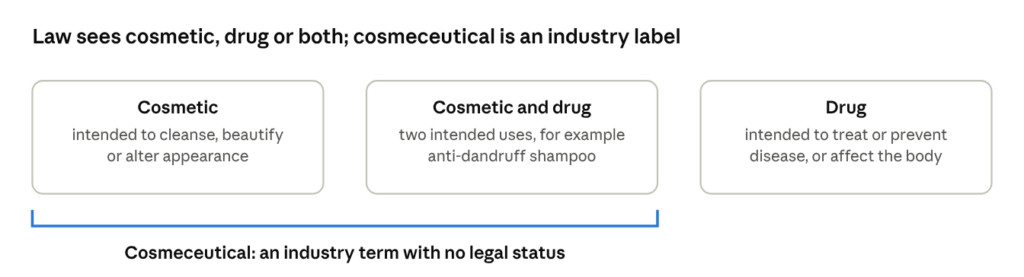
Figure 1. Simplified US product-classification framework. Final classification depends on the product and its intended use.
Industry reports count sun-protection and anti-acne products within cosmeceuticals (IMARC) and anti-dandruff products (Fortune Business Insights). FDA’s guidance uses anti-dandruff shampoo as its example of a product that is both a cosmetic and a drug.
How US law classifies products
| Category | Defined by | Examples |
|---|---|---|
| Cosmetic | Intended use: cleansing, beautifying, promoting attractiveness or altering appearance | Skin moisturizers, perfumes, lipsticks, shampoos, toothpastes, deodorants |
| Drug | Intended use: diagnosis, cure, mitigation, treatment or prevention of disease, or affecting the structure or any function of the body | An anti-dandruff treatment |
| Both | A product with two intended uses | Anti-dandruff shampoo; fluoride toothpaste; antiperspirant deodorant; moisturizers and makeup marketed with sun-protection claims |
Source: FDA
Global Cosmeceuticals Market size
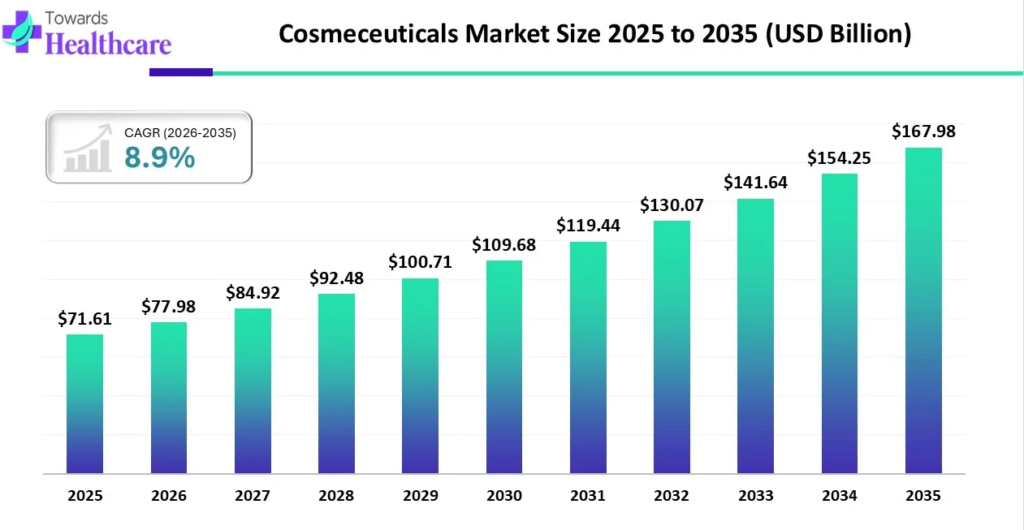
The global cosmeceuticals market was valued at US$ 71.61 billion in 2025 and is expected to grow to US$ 77.98 billion in 2026. By 2035, the market is projected to reach approximately US$ 167.98 billion, expanding at a CAGR of 8.9% from 2026 to 2035 according to Towards Healthcare
What Is Driving Growth in the Cosmeceuticals Market?
- Rising demand for science-backed skincare: Growing consumer interest in products targeting skin aging, acne, hyperpigmentation, and hydration.
- Growing preference for active ingredients: Increased interest in antioxidants, vitamins, peptides, and other functional ingredients.
- Demand for natural and botanical formulations: Rising interest in plant-derived ingredients and products positioned around natural skincare.
- Expansion of the hair care segment: Growing demand for specialized products targeting scalp health, dandruff, and hair loss.
- Growth of e-commerce: Online retail is expanding access to cosmeceutical products and enabling brands to reach wider audiences.
- Advances in formulation technology: Innovations in ingredient delivery systems, AI-assisted formulation, and product development are creating new opportunities.
- Increasing market demand: The global cosmeceuticals market is projected to grow from US$71.61 billion in 2025 to US$167.98 billion by 2035, at a CAGR of 8.9% from 2026 to 2035.
Key Challenges in Cosmeceutical Manufacturing
- High product development costs: Research, formulation development, stability testing, and product validation can increase development costs.
- Regulatory complexity: Requirements for product classification, ingredient safety, labeling, and marketing claims vary across markets.
- Challenges in formulation stability: Maintaining the stability, compatibility, and performance of active ingredients can be technically demanding.
- Ingredient sourcing challenges: Variations in the quality, availability, and consistency of botanical extracts and specialized ingredients can affect production.
- Intense market competition: Established brands and new entrants compete on product efficacy, innovation, pricing, and differentiation.
- Consumer skepticism: Unsupported efficacy claims and concerns about product safety can undermine consumer confidence.
- Manufacturing scale-up challenges: Maintaining product consistency, quality, and performance when moving from laboratory development to commercial production can be difficult.
How cosmeceutical manufacturing works
Takeaway: most projects can be understood through three broad phases: Design, Prove, and Make & Release. This three-phase grouping is our editorial framework, not a regulatory sequence, and the exact steps can vary by product, manufacturer, and target market.
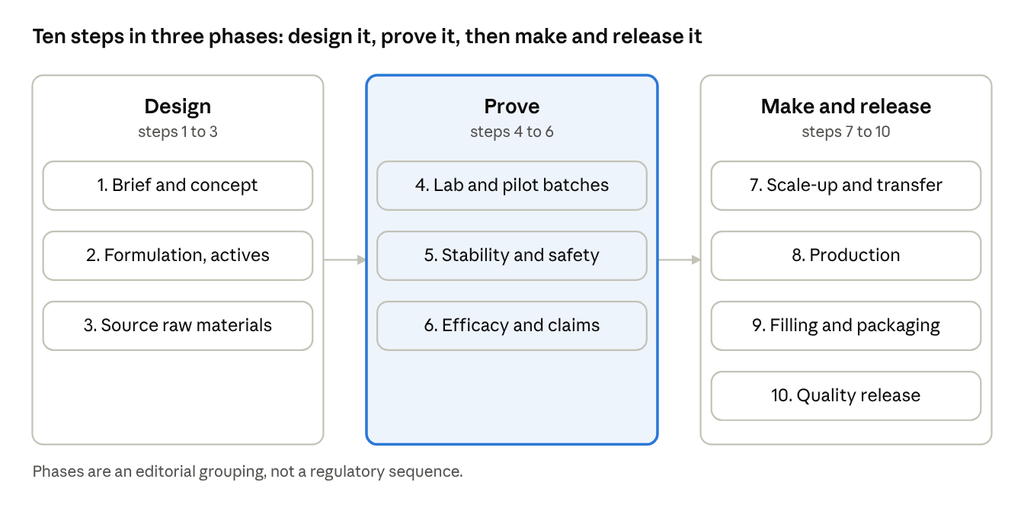
Figure – Ten manufacturing steps in three phases
Phase 1: Design (steps 1 to 3)
- Brief and concept. The brand sets the skin concern, claims, texture, packaging and target markets. Target markets matter early because the rules differ by market (section 4)
- Formulation and active selection. Ingredient types tracked by market publishers include antioxidants, sunscreens, botanicals, peptides and proteins, exfoliants, moisturizers and retinoids
- Source and qualify raw materials. For the EU Product Information File, safety data sheets, specifications and certificates of analysis are usually included, so supplier paperwork starts here
Phase 2: Prove (steps 4 to 6)
- Lab and pilot batches. Small batches test whether the formula can be made repeatedly and supply samples for testing
- Stability and safety. In the EU, safety is assessed in a Cosmetic Product Safety Report by a qualified safety assessor. In the US, MoCRA requires the responsible person to keep records showing adequate substantiation of safety
- Efficacy and claims evidence. The more a product claims, the more evidence it needs, and treatment claims can make it a drug
Phase 3: Make and release (steps 7 to 10)
- Scale-up and technology transfer. The approved formula moves from lab to production equipment and the manufacturer confirms the product matches the pilot
- Production. Creams and lotions can be oil-in-water or water-in-oil emulsions. A typical process prepares an oil phase and a water phase separately, disperses actives in the appropriate phase, and combines the phases to form the emulsion
- Filling and packaging. In the EU the label must carry the name and address of the Responsible Person.
- Quality release and records. The EU Product Information File must be kept for 10 years after the last batch is placed on the market. Under MoCRA, FDA product listings must be updated when product information changes
Technology Transfer and Commercial Scale-Up
Moving a formula from the laboratory to commercial production requires more than increasing batch size. Mixing speed, heating and cooling rates, ingredient addition order, equipment geometry, and process duration can affect texture, stability, and consistency.
A structured technology-transfer package should document the approved formula, manufacturing instructions, critical process parameters, in-process checks, and finished-product specifications. Pilot batches and comparisons with commercial batches help identify problems before full-scale production. Brands should also agree how ingredient substitutions, process changes, and equipment adjustments will be reviewed and approved.
Sustainable and Advanced Cosmeceutical Manufacturing
Brands can assess sustainability across ingredient sourcing, packaging, water and energy use, and production waste. Recyclable packaging, concentrated products, and responsibly sourced ingredients may support sustainability goals when suitable for the product and local recycling systems. Claims should be specific and supported by evidence.
Digital batch records, automated process controls, and data-driven monitoring can improve documentation and help identify production inconsistencies. When evaluating a manufacturer’s capabilities, ask for measurable information about its processes rather than relying only on broad descriptions such as “green manufacturing” or “smart factory.”
Cosmeceutical Regulations by Market
Takeaway: because “cosmeceutical” is not a legal term, the rules depend on how each market classifies the product. Confirm requirements with a regulatory specialist before launch.
United States
- Classification turns on intended use.
- Facility registration and product listing. Under MoCRA, domestic and foreign manufacturers and processors of cosmetics distributed in the US must register each facility with FDA. Foreign facilities must designate a US agent, and registrations are renewed every two years. As of 6 January 2026 FDA’s system showed 14,299 active facility registrations and 992,907 active product listings.
- Safety substantiation and adverse events. The responsible person must keep safety substantiation records. FDA launched a public adverse event dashboard for cosmetics on 12 September 2025.
- Mandatory recalls. MoCRA gives FDA authority to mandate recalls of adulterated or misbranded cosmetics that present a serious risk; FDA issued draft guidance on 18 December 2025.
- GMP. MoCRA requires FDA to set cosmetic GMP regulations. As of January 2026 none were final, and FDA had already sent warning letters to facilities that make both drug and cosmetic products.
- Other open items (as of January 2026). Fragrance allergen rules had not been issued. FDA withdrew its proposed talc-testing rule on 28 November 2025. Its PFAS report of 29 December 2025 reached no definitive safety determinations.
Insight: until GMP rules are final, expect buyers to ask for ISO 22716. It is the standard the EU system uses, and Foley advises companies to use the interim period to tighten their quality systems.
European Union
- Regulation (EC) No 1223/2009 is the primary legislation. A Responsible Person established in the EEA is responsible for product safety; this can be the manufacturer, the importer or the person who commissioned the product.
- Per product: a Cosmetic Product Safety Report, a Product Information File held at the Responsible Person’s address, and notification through CPNP (Article 13).
- Ingredients: Annex II lists prohibited substances.
- GMP: Article 8 makes GMP a prerequisite. Compliance with ISO 22716 is not mandatory, but manufacturers that comply are legally presumed to comply. The law does not require GMP certification, only a statement of compliance with a recognized standard. The Product Information File should include a declaration of conformit with ISO 22716.
India
- Imports: cosmetics must be registered with the Central Licensing Authority (CDSCO) before import, under the Drugs and Cosmetics Act, 1940 and the Cosmetics Rules, 2020. The registration covers pack size, variants and manufacturing premises.
- Manufacturing licenses are granted by State Licensing Authorities. A loan license lets a company manufacture at another licensee’s site, which is relevant to contract manufacturing (Cosmetics Rules, 2020).
- Standards: the Bureau of Indian Standards maintains ingredient lists under IS 4707. An Italian trade agency note (ICE New Delhi, May 2026, in Italian) says there is no general mandatory BIS certification for cosmetics, although CDSCO uses BIS standards as a technical benchmark
China
- Under the 2020 Cosmetics Supervision and Administration Regulations, cosmetics are either special cosmetics (anti-freckle and whitening, sunscreen, hair dye, hair perm, anti-hair loss, and new efficacies) or ordinary cosmetics
- Special cosmetics need registration with NMPA; ordinary cosmetics need filing. Foreign companies must appoint a domestic responsible person
Insight: the “responsible person” appears in the US, EU and China. MoCRA defines it as the manufacturer, packer or distributor named on the label; the EU and China require a named person for each product or filing. Choose a manufacturer that can support the documentation each target market asks for.
Quality Assurance, Batch Traceability, and Post-Market Safety
Quality assurance continues after production. Manufacturers should have documented procedures for incoming-material checks, in-process monitoring, finished-batch review, deviations, and corrective actions. Batch records and traceability systems help brands identify affected products if a quality issue occurs.
A written quality agreement should define responsibilities for batch release, complaints, serious adverse events, retained samples, investigations, recalls, and access to documentation. In the United States, MoCRA requires the responsible person to report serious adverse events to FDA within 15 business days. Confirm the relevant obligations in each market. (Source: FDA — MoCRA)
How to Choose a Cosmeceutical Manufacturing Partner
Check regulatory requirements and product classification first, then assess manufacturing quality, technical capabilities, market-specific documentation, and commercial terms. Ask for written evidence rather than relying only on sales assurances.
| Check | What to ask | Why it matters |
| 1. Regulatory registration | Is the facility registered where required, and can the manufacturer explain its role in product listing or registration? | Registration is not product approval; verify the applicable obligations and any exemptions. |
| 2. Product classification | Do the formula and claims make the product a cosmetic, a drug, or both in the target market? | Classification affects testing, labeling, and market access. |
| 3. GMP and quality systems | Can they provide quality procedures, recent audit findings, deviation/CAPA records, and evidence of GMP practices? | Shows whether production and documentation are controlled. |
| 4. Testing capabilities | What stability, microbiological, preservative efficacy, and packaging-compatibility testing can they support? | Helps identify formulation and shelf-life risks before launch. |
| 5. Market documentation | Can they support required safety reports, product files, notifications, or registrations for target markets? | Documentation responsibilities differ by market and product. |
| 6. Manufacturing capabilities | Can they make the required format, batch size, texture, and packaging, and scale up reliably? | Confirms technical fit and future capacity. |
| 7. Raw materials and traceability | How are suppliers qualified, incoming ingredients tested, and batches traced? | Supports consistency and investigations if problems arise. |
| 8. Commercial terms and ownership | What are MOQ, lead time, price, payment terms, formula ownership, confidentiality, and change-control terms? | Written terms reduce disputes and clarify responsibilities. |
Frequently Asked Questions-
1- What is the difference between a cosmetic and a cosmeceutical?
Cosmetics are intended to cleanse or beautify. Cosmeceuticals are described by market publishers as combining cosmetics with bioactive ingredients. The difference is positioning and performance, not legal status.
2- Are cosmeceuticals regulated as drugs?
Not as a category. FDA sorts products by intended use; a product with treatment claims, or with a drug use such as dandruff treatment, is a drug.
3- How big is the cosmeceuticals market?
2025 estimates range from $66.3B to $74.31B, depending on what is counted.
4- Which region is largest?
Asia Pacific, with a 41.43% share in 2025 according to Fortune Business Insights.
5- Is ISO 22716 mandatory in the EU?
No, but it gives a legal presumption of GMP compliance.
6- Must a US cosmetics manufacturer register with FDA?
Yes. MoCRA requires facility registration for domestic and foreign facilities, renewed every two years.
7- What is a Responsible Person?
In the EU, the person responsible for a product’s safety and compliance. Under MoCRA, the manufacturer, packer or distributor named on the label.
8- Do I need approval to sell in China?
Yes: registration for special cosmetics or filing for ordinary cosmetics, with a domestic responsible person for foreign companies.
9- Can I import cosmetics into India?
Only with import registration from CDSCO.
10- What do minimum order quantities, lead times and costs look like?
They vary by manufacturer and product. We have no verified benchmark, so ask each manufacturer for written quotes.