Dietary supplement contract manufacturing in India means outsourcing the formulation, production, packaging and often testing of health supplements and nutraceuticals to an Indian manufacturer that holds the required FSSAI licenses and operates to defined quality standards. Brands use it to launch products without building a plant, and India’s growing domestic supplement market and manufacturing base make it a significant option for both Indian and overseas brands.
Choosing well takes more than comparing prices. Indian supplements are regulated under their own framework, which differs from U.S. and European rules on permitted ingredients, licensing, claims and labeling. This guide explains the market context, the FSSAI regulatory basics, what a capable manufacturing partner looks like, and the questions to ask before you commit.
Why India for supplement contract manufacturing?
Several factors make India attractive. Market growth is a major one, although estimates vary a great deal between publishers. Ken Research, for example, values the Indian dietary supplements market at about USD 5.85 billion in 2026, growing at a forecast CAGR of 12.33 percent to roughly USD 11.75 billion by 2031. Another publisher, Expert Market Research, puts the market at USD 6.84 billion in 2025, growing at 15.82 percent a year to USD 29.71 billion by 2035. The two figures differ in scope and methodology, so treat any single number with caution and cite the publisher and year.
Beyond demand, India has an established manufacturing ecosystem. Ken Research notes that the food-processing sector accounts for about 12.9 percent of organized manufacturing employment and provides formulation, packaging and quality-control capabilities that support scalable supplement manufacturing and contract production. Market reports also track the full range of dosage forms, including tablets, capsules, powders, liquids and softgels, which suggests that most mainstream formats are produced domestically.
For brands, the main reasons to consider India are access to established capacity, a broad range of dosage forms, experience with botanical and herbal ingredients, and the ability to serve both the domestic market and exports. The trade-off is that you need to understand local regulation and verify quality carefully.
The regulatory framework: FSSAI basics
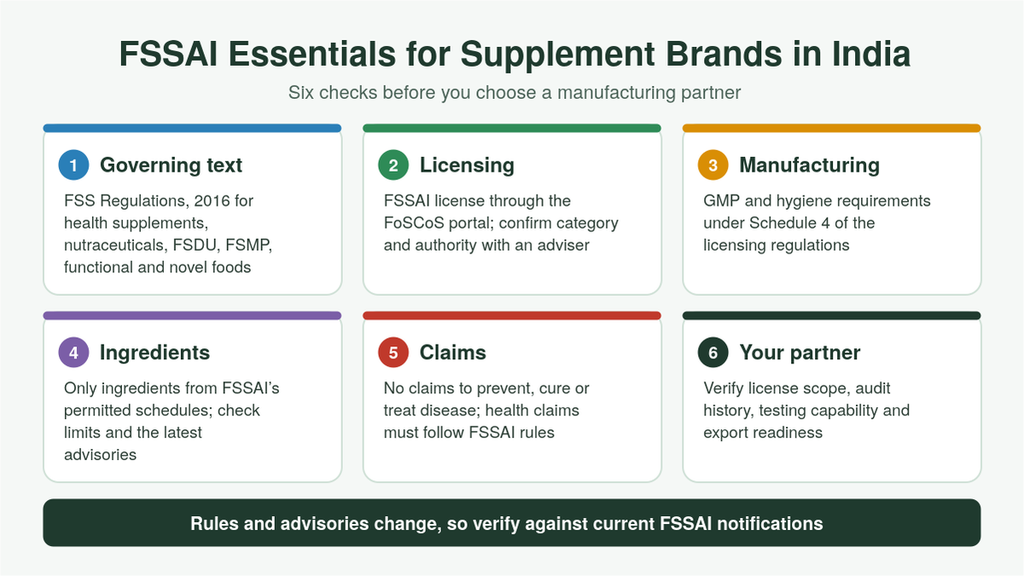
Supplements in India are regulated by the Food Safety and Standards Authority of India (FSSAI). The principal regulation is the Food Safety and Standards (Health Supplements, Nutraceuticals, Food for Special Dietary Use, Food for Special Medical Purpose, Functional Food and Novel Food) Regulations, 2016. These regulations apply to composition, labeling, claims, manufacturing, imports and sales.
One analysis notes that the 2016 Regulations remain the notified text, that food businesses had to comply by 1 January 2018, and that FSSAI’s own advisories in 2026 still cite them. The same analysis says it found no final notification of a revised 2022 draft. Regulations and advisories can change, so always check current FSSAI notifications before finalizing a formula or label.
Licensing
There is no separate product registration certificate for each supplement. Instead, businesses need an appropriate FSSAI license and the product must meet current requirements, with licenses issued through the FoSCoS online portal. FSSAI’s own guidance says that manufacturers and importers must register or obtain a license from the authority. One compliance adviser states that manufacturers, importers and marketers of health supplements and nutraceuticals need a Central License regardless of production capacity. License category and authority depend on the business activity, so confirm the correct one with a regulatory adviser before relying on a manufacturer’s statement.
GMP and hygiene
Manufacturing units must comply with Schedule 4 of FSSAI’s licensing regulations, which covers general hygienic and sanitary practices. In practice, buyers should treat this as a baseline and ask for further evidence of quality systems, such as audit history, documentation practices and third-party certification.
Permitted ingredients
FSSAI nutraceutical rules limit ingredients to those listed in the regulation’s schedules. FSSAI’s guidance lists vitamins and minerals, essential amino acids and other nutrients, and plant and botanical ingredients among the permitted categories, and the 2016 text places plants and botanicals in Schedule IV. Other categories, such as probiotics and prebiotics, have their own lists. Different publications number the schedules differently, so check ingredient names and limits against the notified text.
This matters for formulation. An ingredient or dose that is routine in the U.S. may not be permitted in India, and an ingredient popular in India may face restrictions elsewhere. FSSAI also issues advisories on specific ingredients, such as an April 2026 advisory on ashwagandha cited in one regulatory explainer.
Claims and labeling
Health supplements cannot claim to prevent, cure or treat disease. Health and nutritional claims must follow FSSAI’s rules, and one regulatory summary says health claims must be based on the nutrients or ingredients listed in the regulation’s schedules. Labels must also meet FSSAI’s packaging and labeling requirements. Plan formula, label and claims together, since a claim that is possible in one market may not be permitted in another.
What a capable Indian manufacturing partner looks like
Licenses are a minimum. Look for evidence across the following areas:
- Valid, correctly scoped FSSAI license. Check that it covers your product category, names the actual manufacturing site and is current.
- Quality system maturity. Ask about documentation, batch records, deviation handling, change control and internal audits, and about how these compare to standards such as the NSF/ANSI 455-2 GMP standard for dietary supplements.
- Relevant certifications. Certifications such as ISO 22000 or FSSC 22000 can add confidence, but they are food safety system certifications, not supplement-specific proof.
- Testing capability. In-house or accredited external labs for identity, potency, heavy metals, microbiology and, for botanicals, pesticide residues.
- Ingredient sourcing and traceability. Supplier qualification, lot traceability and documentation for botanical and imported ingredients.
- Formulation expertise within FSSAI rules. Experience designing products that comply with permitted ingredient lists and dose limits.
- Dosage form capability. Proven experience in your format, whether capsules, tablets, softgels, powders, gummies or liquids.
- Stability data for local conditions. Much of India falls in the hot-humid Zone IVa, where long-term studies use 30°C and 65 percent relative humidity, so stability data should reflect real distribution conditions.
- Export readiness. Experience with export documentation and the requirements of your target markets.
If you plan to sell outside India
Many brands manufacture in India to serve several markets. Each market has its own rules, and a product that meets FSSAI requirements is not automatically compliant elsewhere.
- United States. Supplements sold in the U.S. need to be made under FDA’s 21 CFR Part 111 GMP requirements, with U.S. labeling and claims rules. Ask any Indian manufacturer how it meets Part 111 for U.S.-bound products, and whether it has experience with FDA inspections.
- European Union and United Kingdom. Ingredient permissions, vitamin and mineral limits and health claim rules differ from both India and the U.S.
- Other markets. Middle Eastern, Southeast Asian and other regulators have their own registration processes and documentation requirements.
The practical approach is to decide your priority markets first, then build the formula, specifications and documentation around the strictest requirements you need to meet. Reformulating after a launch is expensive.
Contract manufacturing models in India
The models are broadly the same as elsewhere. Brands can use white label products, semi-custom private label or fully custom formulation, and these terms are used inconsistently by manufacturers. Our guide to private label vs. white label vs. custom supplements covers how to compare them. In India, three points deserve particular attention:
- License and brand roles. Confirm who holds the manufacturing license, and what license or registration your brand needs as the marketer. Requirements for brand owners should be confirmed with a regulatory adviser.
- Formula and ingredient compliance. Check that the formula was designed for FSSAI’s ingredient lists and dose limits, and who is responsible for updating it if rules change.
- Ownership and transfer rights. Get formula ownership, exclusivity and technology transfer terms in writing.
Questions to ask before you choose
- Which FSSAI licenses do you hold, for which products and at which site?
- Can I see your most recent audit reports, certifications and corrective actions?
- Which formats do you make, and what are your minimum order quantities?
- Do you formulate within FSSAI ingredient lists and limits, and how do you handle rule changes?
- Which tests do you run, and in which labs? Are those labs accredited?
- How do you source, qualify and trace botanical and imported ingredients?
- What stability data do you have for hot and humid conditions?
- What export experience do you have, and with which regulators?
- Who owns the formula, and can I transfer production if needed?
- Can I audit your plant, and will you sign a quality agreement?
Common mistakes brands make
- Choosing on price alone. Low quotes can hide weak quality systems, limited testing or ingredient substitution risk.
- Assuming a license proves quality. A license shows legal authorization, not capability for your product.
- Using ingredients or claims that do not fit local rules. Formulas written for another market can fail FSSAI requirements.
- Ignoring stability in hot, humid conditions. Shelf life data from temperate conditions may not hold in distribution.
- Skipping audits. Remote reviews miss problems that a site visit would reveal.
- Not defining responsibilities. Without a quality agreement, no one owns complaints, recalls or change control.
- Neglecting exit planning. Without transfer rights, switching partners can mean starting over.
A selection checklist
- Define your priority markets and the regulations that apply.
- Shortlist manufacturers with valid, correctly scoped FSSAI licenses.
- Review audit history, certifications and documentation practices.
- Verify testing capability and ingredient traceability.
- Confirm that formulas comply with permitted ingredient lists and limits.
- Ask for stability data suited to your climate and distribution.
- Visit or audit the site before the first order.
- Sign a quality agreement and a supply agreement that cover ownership, change control and recalls.
- Plan how you will track regulatory changes.
Frequently asked questions
Which regulator oversees supplements in India?
The Food Safety and Standards Authority of India (FSSAI), mainly under the 2016 regulations covering health supplements, nutraceuticals, food for special dietary use, food for special medical purpose, functional food and novel food.
Do supplements need product registration in India?
There is no separate registration certificate for each supplement. Businesses need an appropriate FSSAI license through the FoSCoS portal, and products must meet the regulations.
Can I use any ingredient in an Indian supplement?
No. Ingredients must come from the permitted schedules in the regulations, with dose limits. Check the notified text and current FSSAI advisories.
Can an Indian supplement make disease claims?
No. Health supplements cannot claim to prevent, cure or treat disease, and other claims must follow FSSAI rules.
Can I sell supplements made in India in the U.S.?
Possibly, but the product must meet U.S. requirements, including FDA’s Part 111 GMP rules, labeling and claims. Check this with your manufacturer and a U.S. regulatory adviser.
How big is the Indian supplement market?
Estimates vary widely by publisher. Examples include about USD 5.85 billion in 2026 (Ken Research) and USD 6.84 billion in 2025 (Expert Market Research), both growing at double-digit rates.
Conclusion
India offers capacity, range and growing demand for supplement contract manufacturing, but success depends on understanding FSSAI rules and verifying quality beyond the license. Brands that define their target markets early, formulate within permitted ingredient lists, audit their partners and put responsibilities in writing can make India a reliable base for both domestic and export products.