Technology transfer in nutraceutical manufacturing is the structured handoff of a product, its process, specifications, analytical methods, and manufacturing knowledge from development into repeatable commercial production. For supplement companies, the transfer may happen from an internal R&D team to a manufacturing site, between two manufacturing sites, or from one manufacturer to another. The objective is not simply to reproduce a formula. It is to reproduce the intended product consistently at a different scale, on different equipment, with documented controls that support quality and regulatory compliance.
A successful transfer sits at the intersection of formulation science, process engineering, quality, sourcing, analytical testing, and project management. Weak transfers often reveal themselves only at pilot or commercial scale, when powders stop flowing, gummies behave differently in depositing, tablets fail hardness targets, yields fall, flavors shift, or a new raw-material grade changes processing behavior.
What is technology transfer in nutraceutical manufacturing?
Technology transfer converts development knowledge into a manufacturing system that another team or facility can execute reliably. The receiving site needs enough information to understand not only what to make, but how the product behaves and which variables matter most.
For a dietary supplement, that typically means transferring the formulation and bill of materials, ingredient specifications, supplier information, manufacturing instructions, process parameters, in-process controls, finished-product specifications, analytical methods, packaging requirements, stability information, and the rationale behind important development decisions.
In the United States, 21 CFR Part 111 provides an important regulatory framework. Dietary supplement manufacturers must establish specifications at points where control is necessary, prepare and follow a master manufacturing record for each unique formulation and batch size, create batch production records, and operate quality control systems that approve or reject processes, specifications, controls, and deviations that can affect product quality.
Why technology transfer is different in nutraceutical manufacturing
Nutraceutical technology transfer shares many principles with pharmaceutical technology transfer, but the technical challenges can look different because of the wide variation in ingredients, dosage forms, and manufacturing processes used across the sector.
Raw materials can have significant physical and functional differences even when they meet the same nominal specification. Botanical extracts, probiotics, proteins, minerals, flavors, sweeteners, and excipients may vary in particle size, moisture, bulk density, viscosity, potency, flow properties, or carrier systems. These differences can influence blending, compression, encapsulation, depositing, drying, and finished-product performance.
Dosage form also has a major influence on transfer complexity. A simple powder blend may be relatively straightforward to reproduce, while a gummy formulation may depend on a tightly controlled combination of temperature, solids concentration, pH, viscosity, depositing, and curing conditions.
This means the transfer strategy should be risk-based rather than document-based. The objective is not to transfer every piece of information with equal weight, but to identify which product and process variables have the greatest potential to affect quality, manufacturability, and commercial performance.
When is a technology transfer needed?
A formal transfer is valuable whenever responsibility for making a product changes or the manufacturing system changes materially. Common examples include:
- Moving a newly developed supplement from a formulation laboratory to a commercial manufacturing site
- Transferring an established SKU to a new manufacturer
- Adding a second manufacturing site for supply resilience
- Scaling from pilot to commercial batch sizes
- Changing major equipment or process configuration
- Bringing an externally developed formulation into an internal manufacturing network
The transfer burden should reflect the product and the degree of change. A straightforward powder blend may require a different risk assessment from a high-load tablet, a moisture-sensitive probiotic, a multi-phase gummy, a softgel, or a complex botanical extract. The more sensitive the product is to raw materials, sequence, shear, temperature, humidity, residence time, or equipment geometry, the more important tacit process knowledge becomes.
Technology transfer vs. scale-up: what is the difference?
Technology transfer and scale-up are closely connected, but they are not the same activity.
Scale-up focuses primarily on moving a formulation or process from one production scale to another while maintaining the required product characteristics. Technology transfer is broader: it involves transferring the knowledge, documentation, process understanding, analytical requirements, and manufacturing controls needed for another team or site to reproduce the product.
A commercial transfer may therefore include scale-up work, but it also needs to address equipment differences, raw-material equivalence, analytical methods, documentation, quality responsibilities, packaging, and change control.
In practice, the two activities should be planned together. A process that has never been properly characterized during development can create significant uncertainty when it reaches the receiving manufacturing site.
The technology transfer process
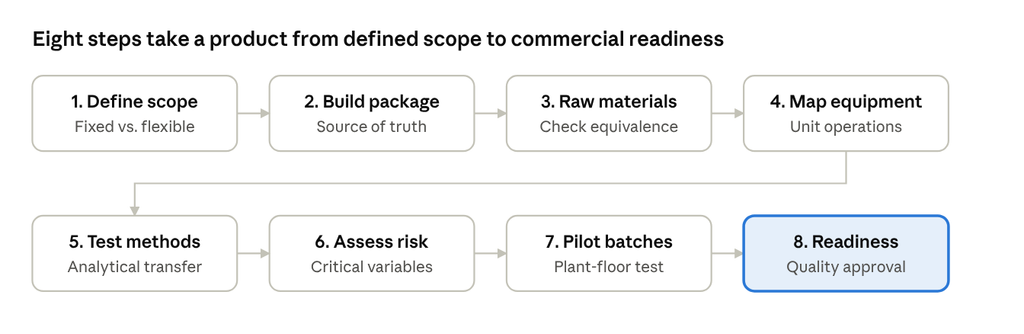
The eight steps run from scope definition to quality approval, with the risk assessment completed before any pilot batch.
Step 1: Define the product and transfer scope
Start by defining exactly what is being transferred. The receiving site should understand the target product profile, dosage form, serving size, ingredient quantities, claims, packaging format, target markets, expected batch size, and commercial volume. The project should also identify what is fixed and what can still change.
This prevents a common failure mode: beginning manufacturing work while formulation, sourcing, packaging, or label decisions are still moving. A transfer can accommodate controlled changes, but unresolved fundamentals create repeated rework.
Step 2: Build the transfer package
The transfer package is the technical source of truth. It should bring together the formula, component specifications, approved or proposed suppliers, manufacturing process, equipment assumptions, analytical methods, acceptance criteria, stability data, packaging requirements, and development history.
For U.S. dietary supplements, the eventual master manufacturing record must contain the product name, strength or amount of each dietary ingredient, complete component list, component quantities, theoretical yields, packaging information, process specifications, sampling and testing procedures, manufacturing instructions, precautions, and corrective-action provisions. Building the transfer package with these requirements in mind reduces the gap between development documentation and commercial execution.
The information that cannot be found in the formula
One of the most difficult elements of technology transfer is knowledge that exists outside formal documentation.
Development teams often know which parameters are particularly sensitive, which ingredients require special handling, which processing steps have previously caused problems, or which apparent process changes have little practical impact. If this knowledge remains with individual scientists or operators, it can disappear when the product moves to another facility.
A strong transfer therefore asks a second question alongside “What documents do we need?”: “What does the development team know that is not yet documented?”
This can be captured through structured technical workshops, development-history reviews, manufacturing demonstrations, risk assessments, and direct interaction between sending and receiving teams.
Step 3: Assess raw-material equivalence
Ingredient name alone is rarely enough. Two materials that look equivalent on a label can behave differently in manufacturing because of particle-size distribution, bulk density, moisture, viscosity, potency, carrier system, botanical source, excipients, or other physical attributes.
The transfer team should identify which raw-material characteristics affect manufacturability and finished-product performance. If the receiving site uses a different supplier or grade, equivalence should be evaluated before the first commercial-scale batch rather than treated as a purchasing substitution.
Step 4: Map the process to the receiving equipment
Technology transfer is not a literal copy-and-paste of equipment settings. A development blender, tablet press, gummy cooker, or encapsulation line may not behave like the receiving site’s commercial equipment. Scale changes mixing dynamics, heat transfer, shear, residence time, fill behavior, and yield.
The team should translate the development process into unit operations and identify the parameters that control each stage. For a powder product, this could include order of addition, screening, pre-blending, blender loading, blend time, and environmental controls. For tablets, it may extend to granulation, lubrication time, compression force, and tooling. Gummies can introduce cooking temperature, solids concentration, pH, depositing conditions, cooling, and curing.
Step 5: Transfer analytical methods and specifications
The receiving site needs clear specifications for incoming materials, in-process controls, and the finished product, together with suitable methods for determining whether those specifications are met. Under Part 111, specifications are required for components, relevant in-process stages, labels and packaging, and the finished batch.
Method transfer should confirm that the receiving laboratory can execute the required testing appropriately. Depending on the product, this may include identity, potency or strength, microbiological testing, contaminants, moisture or water activity, physical attributes, and dosage-form-specific tests.
Step 6: Conduct a transfer risk assessment
Before manufacturing the first engineering or pilot batch, the sending and receiving teams should identify where the greatest transfer risks are likely to occur. Typical risk areas include:
- Raw-material variability
- Equipment differences
- Batch-size changes
- Critical process parameters
- Product quality attributes
- Environmental conditions
- Analytical capability
- Operator-dependent steps
- Packaging differences
- Known development problems
- Supply-chain or supplier changes
Not every parameter requires the same level of control. The purpose of the risk assessment is to distinguish genuinely critical variables from parameters where the receiving site has reasonable operating flexibility.
This allows engineering and pilot batches to answer specific technical questions rather than becoming an expensive trial-and-error exercise.
Step 7: Manufacture pilot or engineering batches
A pilot or engineering batch tests the assumptions made on paper. The goal is to observe how the formulation behaves on the intended equipment and to identify adjustments before routine commercial production.
Teams should capture actual process settings, observations, yields, sampling results, deviations, and operator feedback. Unexpected behavior is useful information if it is investigated and fed back into the manufacturing instructions and control strategy.
Step 8: Confirm commercial readiness
The transfer is complete when the receiving operation can reproducibly manufacture product that meets agreed specifications using approved materials, equipment, procedures, and documentation. Completion criteria should be defined before the project begins.
That may include approved specifications and master manufacturing documentation, qualified suppliers, completed analytical transfer, acceptable engineering or scale-up batches, closed deviations, packaging readiness, stability commitments, and quality approval for routine manufacture.
Practical technology transfer stage-gate
A simple stage-gate approach can help teams decide whether a transfer is ready to move forward:
- Gate 1, Scope defined: Product, process, batch size, markets, responsibilities, and fixed versus flexible elements are agreed.
- Gate 2, Knowledge transferred: The technical package is complete, critical development knowledge has been captured, and major gaps are documented.
- Gate 3, Risk assessed: Raw materials, equipment, analytical methods, process parameters, packaging, and known failure modes have been evaluated.
- Gate 4, Process demonstrated: Engineering or pilot batches show that the receiving site can reproduce the process within agreed operating ranges.
- Gate 5, Commercial readiness: Deviations are closed or appropriately controlled, documentation is approved, quality requirements are met, and routine manufacturing can begin.
What should be in a nutraceutical technology transfer package?
A robust package typically covers nine areas:
- Product and formulation: Formula, bill of materials, ingredient quantities, overages where justified, serving size, and target product attributes.
- Raw materials: Specifications, approved suppliers, certificates, material grades, and critical physical characteristics.
- Manufacturing process: Process flow, order of addition, equipment, operating ranges, hold times, and environmental requirements.
- In-process controls: Sampling points, process checks, limits, yields, and actions when a target is missed.
- Analytical methods: Test methods, method suitability or transfer records, sampling plans, and acceptance criteria.
- Finished-product specifications: Identity, purity, strength, composition, contamination limits, and relevant physical attributes.
- Packaging and labeling: Container-closure system, packaging specifications, label requirements, and line controls.
- Stability: Available development and stability data, storage conditions, shelf-life rationale, and ongoing study requirements.
- Change and deviation history: Known development issues, previous deviations, open risks, and the rationale behind important process decisions.
Why nutraceutical transfers fail
Many transfer problems come from information that was understood by the development team but never converted into controlled manufacturing knowledge. A formulator may know that a botanical powder must be screened before blending, that a flavor system is sensitive to heat, or that a particular excipient grade is essential for tablet compression. If that knowledge is not documented, the receiving team may discover it through a failed batch.
Other recurring causes include incomplete raw-material characterization, assuming equipment scales linearly, transferring nominal settings rather than process understanding, weak analytical alignment, changing suppliers during scale-up, unclear ownership of technical decisions, and treating the first commercial batch as the experiment.
A useful way to think about transfer failure
Most technology-transfer failures can be traced to one of three gaps:
- Knowledge gap: The receiving team does not understand why the process works the way it does.
- Capability gap: The receiving site does not have the equipment, analytical capability, materials, or technical expertise required to reproduce the process.
- Governance gap: Responsibilities, decision rights, escalation routes, or acceptance criteria are unclear.
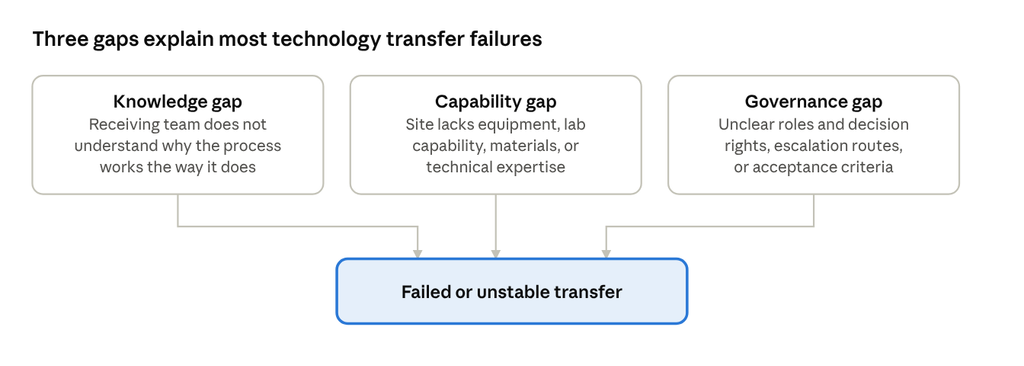
Any one of these gaps can undermine a transfer, and they frequently reinforce each other.
These gaps often overlap. For example, a formulation may fail during scale-up because the receiving site changed an ingredient grade, while the development team had never documented that the original grade was critical. The resulting problem may appear to be an equipment or process issue when the underlying failure was incomplete knowledge transfer.
Technology transfer by dosage form
- Powders: Focus on segregation risk, particle size, bulk density, flow, blend uniformity, screening, order of addition, and blender fill level.
- Tablets: Consider granulation strategy where applicable, flow, lubrication, compression force, tooling, hardness, friability, and disintegration.
- Capsules: Assess powder flow, density, fill-weight control, capsule compatibility, and encapsulation speed.
- Gummies: Control solids, pH, temperature, viscosity, active addition, depositing, cooling, curing, and moisture migration.
- Softgels: Coordinate fill formulation with shell composition, viscosity, encapsulation conditions, drying, and stability.
- Probiotics and other sensitive actives: Pay particular attention to temperature, humidity, oxygen exposure, potency overage strategy, processing losses, and shelf-life performance.
How sending and receiving teams should divide responsibility
The sending team (the product owner or development group) should transfer a clear product definition, development knowledge, and agreed quality requirements. The receiving manufacturer should challenge whether the proposed process is practical on its equipment, identify manufacturing risks, establish site-specific procedures, and demonstrate that the receiving process can consistently meet specifications.
Quality responsibilities should be explicit. Part 111 places defined responsibilities on quality control personnel, including approving or rejecting processes, specifications, written procedures, controls, tests, and examinations that can affect the identity, purity, strength, or composition of the dietary supplement.
The best transfers are collaborative rather than transactional. Development scientists, manufacturing, quality, analytical teams, sourcing, and packaging should resolve uncertainties together before they become deviations on the plant floor.
Questions to ask the receiving site about technology transfer
- How do you assess a new formulation before accepting a transfer?
- How do you identify critical raw-material attributes?
- How do you handle differences between development and commercial equipment?
- What information do you require in the technology-transfer package?
- How do you manage analytical method transfer?
- What does your engineering or pilot-batch process look like?
- How are deviations during transfer investigated?
- Who owns technical decisions when the transferred process does not perform as expected?
- How do you capture development knowledge that is not contained in formal documents?
- What criteria must be met before a product is released for routine commercial production?
A practical technology transfer checklist
- Is the commercial formula frozen and version-controlled?
- Are ingredient specifications and approved sources defined?
- Have critical raw-material attributes been identified?
- Is the manufacturing process mapped by unit operation?
- Are equipment differences between development and commercial scale understood?
- Are process parameters and acceptable operating ranges documented?
- Are in-process and finished-product specifications approved?
- Can the receiving laboratory perform the required analytical methods?
- Are packaging and labeling requirements included in the transfer?
- Have scale-up or engineering batches demonstrated acceptable performance?
- Are deviations, changes, and open risks documented and owned?
- Has quality formally approved readiness for routine commercial manufacture?
Change control after technology transfer
Technology transfer does not end when the first commercial batch is manufactured. Once a product enters routine production, changes to suppliers, raw-material grades, equipment, process parameters, packaging components, or analytical methods can potentially affect the transferred process.
A formal change-control process should therefore assess the potential impact of proposed changes before implementation. The assessment should determine whether additional testing, comparability work, stability data, engineering batches, or customer approval is required.
For U.S. dietary supplements, the 21 CFR Part 111 quality system requirements provide the regulatory foundation for controlling manufacturing and quality-related activities.
Commercial-readiness test
The practical test is simple: could the receiving manufacturer explain what makes this product difficult to manufacture, which variables matter most, what evidence demonstrates process readiness, and what could cause the next batch to fail?
If the answer is yes, the transfer has moved beyond document exchange into genuine process understanding.
Technology transfer is a manufacturing capability, not a document handoff
A technology transfer package is essential, but documents alone do not make a transfer successful. The real objective is to move product and process understanding into a manufacturing system that can repeatedly deliver the intended supplement.
A receiving site should be able to explain how it assesses incoming formulations, identifies scale-up risks, manages raw-material differences, transfers analytical requirements, documents process changes, and decides when a product is ready for routine production.
When those disciplines are built into the project from the beginning, technology transfer becomes more than a route from R&D to the factory. It becomes the mechanism that protects product quality while a formulation is translated into reliable commercial supply.
Frequently Asked Questions
What is technology transfer in nutraceutical manufacturing?
Technology transfer in nutraceutical manufacturing is the structured transfer of product, process, specification, analytical, and manufacturing knowledge from development to another team, site, or manufacturing scale so the product can be reproduced consistently.
Why is technology transfer important for nutraceuticals?
Nutraceutical products can be highly sensitive to raw-material characteristics, equipment differences, processing conditions, and dosage-form behavior. A structured transfer helps convert development knowledge into a reproducible commercial manufacturing process.
What is included in a nutraceutical technology transfer package?
A transfer package typically includes formulation and bill of materials, raw-material specifications and suppliers, manufacturing instructions and process parameters, in-process controls, analytical methods, finished-product specifications, packaging and labeling requirements, stability information, and known changes, deviations, and development risks.
When should a nutraceutical company start technology transfer?
Technology transfer should be considered early enough to identify equipment, raw-material, analytical, and process risks before commercial manufacturing. Planning the transfer alongside scale-up reduces the risk of discovering fundamental manufacturability issues late in the project.
How do you evaluate a receiving site for technology transfer?
Evaluate the site’s experience with the relevant dosage form, raw materials, and manufacturing process, as well as its technical transfer process, analytical capabilities, project management, quality systems, equipment fit, and ability to identify and manage scale-up risks.
What are the most common nutraceutical technology-transfer problems?
Common problems include incomplete documentation, undocumented development knowledge, raw-material variability, equipment differences, weak analytical alignment, supplier changes, unclear responsibilities, and treating the first commercial-scale batch as an experiment.