
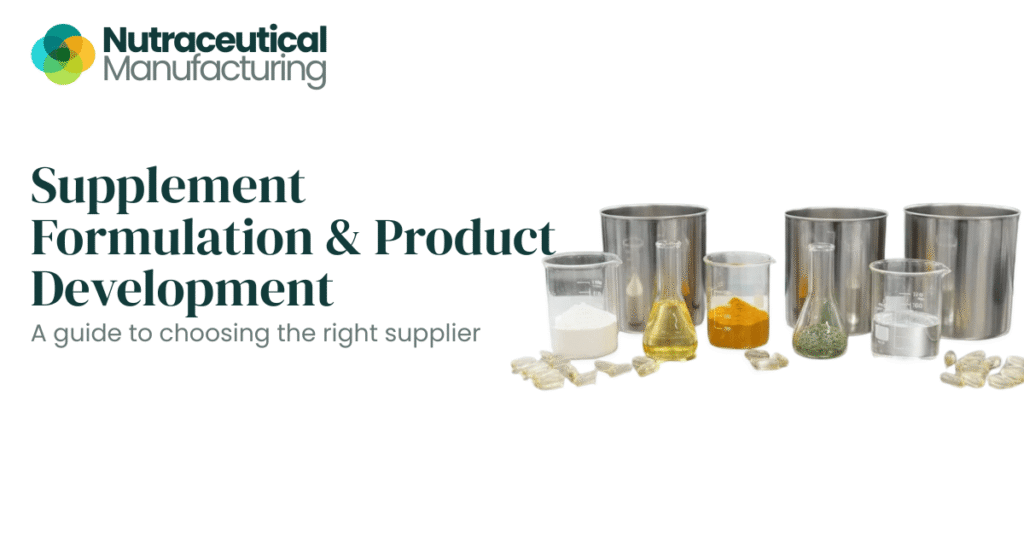
From the first product brief through prototype development, stability testing, pilot production and commercial release, supplement formulation and product development is a cross-functional process that determines whether an idea can become a repeatable, scalable product. The strongest development programs connect formulation science with regulatory strategy, analytical testing, packaging, process development and commercial manufacturing from the beginning.
Supplement formulation and product development turns a product concept into a formula that can be manufactured consistently at commercial scale. The work goes well beyond choosing a list of ingredients. Developers have to balance dose, ingredient compatibility, dosage form, sensory performance, stability, processing behavior, regulatory requirements, cost, packaging and the realities of large-scale manufacturing.
For supplement brands, many expensive problems begin when these decisions are treated separately. A formula can look attractive on paper but prove too large for the intended capsule, too bitter for a powder, too unstable for a gummy, too hygroscopic for the chosen packaging or too difficult to manufacture reliably. Good product development identifies these conflicts before commercial production.
2026 industry and regulatory context: FDA held a March 27, 2026 public meeting on the scope of dietary supplement ingredients, including discussion of newer production approaches such as precision fermentation, cell culture, and recombinant production. For developers, this reinforces the need to assess ingredient identity, manufacturing method, safety information, and market-specific regulatory status early in development.
At a glance: the supplement development pathway
| Stage | What it should accomplish |
| Product concept | Define consumer, positioning, dosage form, target dose, market, sensory profile, cost and launch requirements. |
| Technical feasibility | Check ingredient compatibility, dose and serving-size constraints, equipment fit, sourcing and regulatory pathway. |
| Formulation | Build and optimize the formula, including actives, excipients, flavor, texture and processing behavior. |
| Verification | Use prototypes, specifications, analytical methods, stability studies and packaging evaluations to confirm performance. |
| Scale-up | Translate the bench process into pilot and commercial equipment, with defined parameters and acceptance criteria. |
| Commercial readiness | Lock the formula, manufacturing instructions, packaging, quality documentation and change-control approach. |
What is supplement formulation and product development?
Supplement formulation is the process of defining the ingredients, quantities, excipients and delivery system that make up a dietary supplement. Product development is broader: it takes that formula through feasibility, prototyping, testing, process development, scale-up, packaging and transfer into routine manufacturing.
The output should not simply be an approved sample. It should be a commercially viable product with a defined formula, specifications, manufacturing process, quality controls and packaging system that can be reproduced batch after batch.
Latest Nutraceutical News-
- Dyadic Targets 200 Metric Tons in Alpha-Lactalbumin Deal

- Biofarma Group Takes 70% Stake in EuroPharma Alliance

- Solabia Takes Majority Stake in Ethical Naturals

- Conch Lifescience Raises Tablet Capacity to 300,000

- AstaReal Extends EB15 Astaxanthin to Human Supplements
- Catalent Names Wetteny Joseph to Lead Pharma and Consumer Health

The supplement product development process
Define the product brief
Development should begin with a clear brief rather than an ingredient wish list. The brief typically defines the target consumer, intended positioning, dosage form, serving size, key ingredients or nutrients, sensory expectations, target market, packaging concept, cost target and desired launch timing.
Commercial constraints matter at this stage. A premium once-daily capsule, a high-load sports nutrition powder and a children’s gummy have very different formulation limits. Establishing the non-negotiables early helps the development team identify where trade-offs will be required.
Assess technical and regulatory feasibility
Before bench work begins, the proposed concept should be checked for feasibility. Developers assess whether the desired ingredient levels fit within the selected format, whether ingredients are compatible with one another, whether the product can be processed on available equipment and whether the concept is appropriate for the intended market.
For products sold in the United States, development also needs to connect with the manufacturer’s quality system. FDA dietary supplement cGMP requirements under 21 CFR Part 111 require manufacturers to establish specifications and use a master manufacturing record for each unique formulation and batch size. Development decisions therefore need to become controlled manufacturing instructions rather than remain informal R&D knowledge.
Select ingredients and raw-material specifications
Ingredient selection involves more than choosing an active by name. Different grades and sources can vary in concentration, particle size, bulk density, flow, solubility, taste, color, moisture sensitivity and processing behavior. Those differences can affect both the finished product and the manufacturing process.
Developers also consider the amount of each ingredient required to deliver the target label claim, including the potency of the raw material and any appropriate formulation overages supported by product knowledge and stability data. The supplier’s documentation, traceability, testing requirements, availability, lead time and cost can be as important commercially as the ingredient itself.
Choose the dosage form
The dosage form is a core formulation decision because it changes the technical constraints of the product. Capsules offer a relatively simple route for many dry blends but have finite fill volume. Tablets can achieve compact doses but require a blend capable of reliable compression. Powders can accommodate larger serving sizes but make flavor, dispersibility and moisture control highly visible to the consumer.
Gummies combine formulation with confectionery science: active load, water activity, texture, flavor and heat exposure all need to work together. Liquids introduce questions around solubility, suspension, preservation and packaging compatibility. Softgels are particularly suited to oils and certain lipid-based systems but require specialist encapsulation capabilities.
Build the bench formulation
At bench scale, formulators combine the active ingredients with functional excipients needed to make the product manufacturable and acceptable to use. Depending on the dosage form, these can include carriers, flow aids, binders, disintegrants, lubricants, acids, sweeteners, flavors, colors, stabilizers or anti-caking agents.
This is where formulation becomes an optimization exercise. Increasing active load may reduce room for excipients. Improving flavor may increase cost or serving size. A cleaner label may remove ingredients that make a process more robust. The best formula is therefore not necessarily the one with the longest ingredient list or the highest theoretical dose. It is the one that meets the product brief while remaining stable, manufacturable and commercially viable.
Prototype and iterate
Physical prototypes allow the brand and development team to evaluate the product rather than approve a spreadsheet. Powder projects may require repeated flavor and solubility trials. Gummies may need adjustments to texture, sweetness, acidity and active load. Capsules and tablets may need work on fill weight, flow, compression or disintegration.
Iterations are most useful when each round has a defined purpose. Recording what changed, why it changed and what the sample is intended to test helps development converge on an approved formula instead of cycling through subjective revisions.
Develop specifications and analytical methods
As the formulation matures, the team defines the attributes that will be controlled for raw materials, in-process materials and the finished product. Relevant specifications can include identity, strength or composition, microbiological limits, physical characteristics and other quality attributes appropriate to the product.
Testing strategy should be considered during development, not after the first commercial batch has been made. The laboratory needs methods capable of assessing the ingredients or attributes that matter, and the product matrix must not create avoidable analytical problems.
Evaluate stability and packaging
Stability is a property of the complete product system: formulation, manufacturing process, package and storage conditions. Heat, humidity, oxygen and light can affect sensitive ingredients, while interactions between ingredients can alter color, flavor, texture or potency over time.
Packaging therefore belongs in product development rather than being treated only as a branding decision. Bottle materials, closures, induction seals, desiccants, blister systems, sachet films and other barriers can influence the environment around the product. Stability studies help support shelf-life decisions and show whether the chosen formulation and package remain suitable over time.
Pilot and scale up
A formula that works at laboratory scale is not automatically ready for a commercial production line. Scale changes mixing dynamics, heat transfer, hold times, material movement and equipment settings. Powders can segregate during transfer, tablets can behave differently at higher press speeds and gummies can respond differently when cooking and depositing conditions change.
Pilot or engineering work is used to identify the process parameters that matter and to translate the bench formula into a repeatable manufacturing process. The objective is to understand the operating window before routine production begins.
Lock the commercial formula and manufacturing process
Before launch, the approved formula, raw-material requirements, process instructions, in-process controls, finished-product specifications, packaging configuration and quality documentation should be aligned. In a U.S. cGMP environment, the master manufacturing record becomes a key controlled document for the specific formulation and batch size.
Changes after this point should be managed deliberately. Switching an ingredient grade, supplier, flavor, package component or process parameter can have consequences for stability, sensory performance, analytical results or manufacturing behavior.
Raw-material qualification and supply continuity
Ingredient qualification should address both product quality and supply risk. A technically excellent ingredient is difficult to commercialize if the source cannot provide consistent specifications, reliable documentation or sufficient capacity.
For critical ingredients, the development team should understand the agreed specification, identity and potency requirements, relevant contaminants or microbiological controls, storage conditions, packaging configuration, lead time and change-notification expectations. Where practical, the commercial strategy should also consider qualified alternative sources or grades, because changing a raw material after launch can affect the formula, analytical results, sensory profile and process performance.
Designing for manufacturability before scale-up
A useful formulation is not only chemically or nutritionally plausible. It must also be designed around the equipment, process sequence and material characteristics that will be used in routine production. This is often described as design for manufacturability. Addressing it early can reduce late-stage reformulation and scale-up surprises.
For solid dosage forms, development may need to characterize bulk density, particle-size distribution, flow, moisture, blend uniformity and segregation behavior. For gummies and liquids, factors such as solids content, pH, water activity, viscosity, thermal exposure and filling behavior may become critical. The exact attributes depend on the product and process.
The development team should also identify the process parameters that need tighter control, such as mixing time, order of addition, temperature, shear, compression conditions, cooking or depositing conditions, fill weight and hold time. These decisions should feed directly into the manufacturing instructions and in-process controls used at pilot and commercial scale.
How formulation changes by supplement dosage form
- Capsules – Capsule development is constrained by shell size and fill volume. Formulators need to consider bulk density, flow and the amount of powder required to deliver the target serving. High-dose formulas may require multiple capsules per serving or a change in format.
- Tablets – Tablet formulations need to flow into the die and form a mechanically robust tablet under compression. Binding, lubrication, disintegration and coating can all affect performance. Large ingredient loads can also produce tablets that consumers find difficult to swallow.
- Powders – Powders offer flexibility for high-dose ingredients but place greater emphasis on blend uniformity, flow, dispersibility, flavor and mouthfeel. Hygroscopic ingredients can create caking or processing problems, while ingredients with very different particle properties can increase segregation risk.
- Gummies – Gummy development must balance the supplement actives with the confectionery matrix. Active ingredients can affect flavor, pH, texture, color and processing. Heat-sensitive ingredients also need to be considered in relation to the manufacturing process.
- Liquids and shots – Liquid products require attention to solubility or suspension, pH, microbial control, flavor, physical stability and packaging compatibility. A clear liquid and a suspension can require very different development strategies.
- Softgels – Softgels are commonly used for oils and lipid-soluble ingredients. Development considers the fill material, shell compatibility, migration of components, oxidation risk and the specialized manufacturing process used to form and dry the capsules.
Key formulation challenges
Serving-size constraints – The desired dose may not fit into the intended number of capsules, tablets or gummies.
Ingredient interactions – Components can influence one another’s stability, color, flavor, moisture behavior or processing characteristics.
Taste and odor – Botanicals, minerals, amino acids and other actives can introduce bitterness, astringency, metallic notes or strong aromas that require deliberate sensory development.
Flow and manufacturability – A formula can meet nutritional goals but perform poorly on production equipment because of density, particle-size, cohesiveness or moisture issues.
Stability – Sensitive ingredients can degrade during processing or storage, particularly when exposed to moisture, oxygen, heat or light.
Cost and supply – An excellent prototype is not commercially robust if a critical ingredient has an impractical lead time, unreliable supply or cost that pushes the product beyond its target margin.
Formulation, claims and regulatory considerations
Product development should involve regulatory review early enough to influence the formula and label. Ingredient status, intended use, serving levels and claims can affect whether a concept can be marketed as planned. The requirements also vary by country, so a formula intended for multiple markets may need market-specific review.
In the United States, dietary supplement manufacturers are responsible for manufacturing under applicable cGMP requirements. FDA’s Part 111 framework covers areas including specifications, production and process controls, master manufacturing records, batch production records, laboratory operations, packaging and labeling, quality control and recordkeeping.
U.S. regulatory checkpoints during formulation
For a product intended for the U.S. market, regulatory review should begin before the formula is finalized. The team should assess whether each ingredient is an appropriate dietary ingredient for the intended use, whether a new dietary ingredient notification may be required, and whether proposed label or marketing claims fit the applicable dietary supplement framework.
FDA states that a new dietary ingredient notification generally must be submitted at least 75 days before a dietary supplement containing the new dietary ingredient is introduced into interstate commerce, unless an applicable statutory exception applies. Structure/function and certain related claims require substantiation and notification to FDA no later than 30 days after first marketing, together with the required disclaimer. These requirements make regulatory input part of product development rather than a final label check.
This article focuses on product development rather than legal advice. Requirements can differ by market, ingredient, product category and claim, so brands should obtain market-specific regulatory review before commercialization.
Why stability testing should start during development
Waiting until commercial launch to discover stability problems is expensive. Development teams can use early stability work to compare prototypes, investigate vulnerable ingredients and assess packaging options before the product is locked.
The appropriate program depends on the product. Developers may track analytical potency alongside physical and sensory attributes such as appearance, odor, flavor, texture, dissolution or dispersibility. The aim is to understand whether the finished product remains within its defined quality criteria through the proposed shelf life.
From prototype to commercial manufacturing
Early formulation decisions have a lasting effect on what comes later. The choice of ingredients, dosage form, and processing approach can shape manufacturing feasibility, the range of suitable contract manufacturers, cost of goods, and the path of downstream development. For this reason, formulation and manufacturing strategy should be considered together from the start rather than treated as separate stages.
Technology transfer is the bridge between R&D and routine production. A manufacturing team needs more than the formula percentages. It needs clear material specifications, equipment assumptions, order of addition, processing steps, target parameters, hold conditions, sampling requirements, and acceptance criteria.
This matters most when the formulator and the commercial manufacturer are different organizations. A successful transfer makes the reasoning behind critical choices visible, so the receiving manufacturer can reproduce the product reliably and spot risks early during scale-up.
Working with a supplement formulation and development partner
Brands can develop products internally, with an independent formulator or regulatory consultant, or with a contract manufacturer that has in-house R&D. The right model depends on the brand’s technical resources, intellectual-property strategy, dosage form and need for speed.
An integrated development-and-manufacturing partner can reduce handoffs because the people developing the formula understand the equipment that will ultimately make it. An independent formulation team can provide greater separation between product design and manufacturer selection. In either case, ownership of the formula, specifications, test methods and development documentation should be clear before work begins.
What to ask a supplement manufacturer about product development
- Which dosage forms are formulated and manufactured in-house?
- Who leads formulation work, and what technical disciplines are represented on the R&D team?
- How is technical feasibility assessed before development begins?
- How many prototype or flavor rounds are included in the development process?
- How are raw-material suppliers and ingredient grades selected and qualified?
- What analytical, microbiological and stability testing can be coordinated?
- How is pilot work handled before the first commercial batch?
- How does the team transfer a bench formula to commercial equipment?
- What documentation is supplied when the formula is approved?
- Who owns the final formula and development data?
- How are formula, supplier and process changes controlled after launch?
- Can the same site support manufacturing, packaging and future scale requirements?
What are some important factors that will impact your choice of food supplement formulation partner?
Typical outputs from a robust development program
A well-managed project should progressively create a set of controlled outputs. These can include the approved product brief, ingredient and supplier requirements, bench formula, prototype records, finished-product specification, test requirements, stability plan, packaging specification, manufacturing instructions and scale-up records.
For brands outsourcing production, these outputs also make manufacturer selection and technology transfer more rigorous. They allow potential partners to assess a defined product rather than quote against an incomplete concept.
How long does supplement product development take?
There is no universal timeline. A straightforward capsule based on familiar ingredients can require far less development than a high-active gummy, complex flavored powder or novel delivery system. Ingredient sourcing, prototype rounds, analytical work, packaging development, stability requirements and production scheduling can all affect the critical path.
The fastest project is not necessarily the one with the least development. Resolving feasibility, taste, stability and process risks before the first large batch can prevent much longer delays later.
Commercial-readiness checklist
Before approving a supplement for routine commercial manufacture, the development team should be able to answer the following questions:
- Is the quantitative formula approved, including the intended raw-material specifications and any justified overages?
- Has the dosage form been demonstrated at an appropriate pilot or engineering scale?
- Are critical material attributes and process parameters understood well enough to control the manufacturing process?
- Are finished-product specifications and analytical methods defined and fit for the product matrix?
- Has the formulation and package combination been evaluated for the proposed storage conditions and shelf life?
- Are packaging components, labels and manufacturing instructions aligned with the approved formula?
- Are supplier qualification, change notification and continuity requirements defined for critical ingredients?
- Is the technology-transfer package complete enough for another qualified team to reproduce the product consistently?
- Are formula ownership, development data, specifications, test methods and change-control responsibilities clear in the commercial agreement?
Building a commercially robust supplement
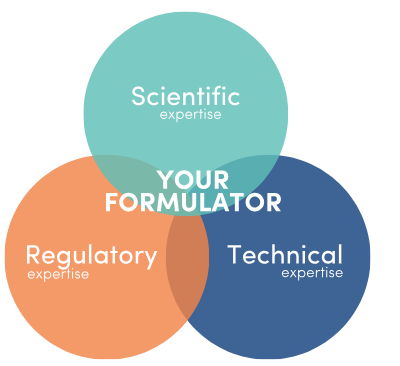
Successful supplement development is a multidisciplinary process. Nutrition and ingredient science shape the concept, formulation science turns it into a workable product, analytical and quality teams define how it will be controlled, and manufacturing engineers determine whether it can be reproduced efficiently at scale.
For brands choosing an outsourced development partner, the strongest indicator is not the number of formulas in a catalog. It is whether the partner can connect formulation decisions to testing, process development, scale-up, quality systems and commercial manufacturing. That connection is what turns a promising prototype into a repeatable product.
Frequently asked questions
What is custom supplement formulation?
Custom formulation is the development of a supplement specifically around a brand’s product brief rather than selecting an existing stock or white-label formula. It can involve ingredient selection, dosage design, excipient selection, flavor development, prototyping and preparation for commercial manufacture.
What is the difference between formulation and product development?
Formulation defines what is in the product and how the ingredients work together. Product development includes formulation but also covers feasibility, prototypes, testing, stability, packaging, scale-up, manufacturing transfer and commercialization.
Do I need a finished formula before contacting a contract manufacturer?
No. Some contract manufacturers offer formulation and R&D services from an initial concept or product brief, while others primarily manufacture formulas supplied by the customer. The important point is to establish the partner’s development capabilities and ownership terms before starting the project.
Why can a supplement formula work in the lab but fail at scale?
Commercial equipment changes how materials are mixed, heated, transferred, compressed, deposited or filled. Larger batches also create longer processing and hold times. Scale-up work is used to understand those differences and define a process that can reproduce the intended product.
When should packaging be selected?
Packaging should be considered during development because it can affect product protection, stability, manufacturability and consumer use. Final packaging decisions should be made with the formulation’s moisture, oxygen, light and physical-protection requirements in mind.