Good Manufacturing Practices (GMPs) are the operating controls that turn a dietary supplement formula into a product that can be manufactured consistently, traced accurately, tested appropriately, and released with confidence. In the United States, manufacturers, packagers, labelers, and holders of dietary supplements are subject to the FDA’s dietary supplement current Good Manufacturing Practice (cGMP) requirements in 21 CFR Part 111.
For supplement brands, GMP compliance is more than a certificate on a contract manufacturer’s website. It affects how ingredients are received and identified, how formulas are translated into manufacturing instructions, how each batch is documented, how deviations are handled, and how finished products are reviewed before release.
What is GMP for dietary supplements?
GMP stands for Good Manufacturing Practice. The FDA generally uses the term current Good Manufacturing Practice (cGMP) to emphasize that manufacturers are expected to use appropriate, up-to-date systems and controls rather than simply follow historic practices.
For dietary supplements sold in the United States, 21 CFR Part 111 establishes requirements for manufacturing, packaging, labeling, and holding operations. FDA describes the rule as setting the minimum practices necessary to help ensure the quality of dietary supplements and that products are packaged and labeled as specified in their master manufacturing records.
Part 111 covers areas including personnel, facilities, equipment, production and process controls, quality control, components, master manufacturing records, batch production records, laboratory operations, manufacturing, packaging and labeling, holding and distribution, returned products, complaints, and recordkeeping.
What does 21 CFR Part 111 require?
The regulation is built around a controlled manufacturing system. Rather than relying on finished-product testing alone, manufacturers must establish specifications and controls at the points where they are needed to ensure product quality.
1. Qualified personnel
Employees must have the education, training, or experience needed to perform their assigned functions. Manufacturers also need appropriate supervision and documented training.
2. Suitable facilities and equipment
Plants, equipment, and utensils must be designed and maintained to support sanitary operations and prevent contamination or mix-ups. Cleaning, maintenance, and equipment use must be controlled and documented where required.
3. Component and supplier controls
Manufacturers establish specifications for components used in dietary supplements and determine whether incoming materials meet applicable specifications before use. Each unique lot must be identifiable and traceable.
A supplier certificate of analysis can support verification of other component specifications, but only when conditions are met: the manufacturer qualifies the supplier by confirming the reliability of its results, the certificate states the methods, limits and actual results, the qualification is documented, the certificate is periodically re-confirmed, and quality control reviews and approves the basis for qualification. Supplier documentation does not replace the manufacturer’s own quality responsibilities. In particular, Part 111 requires at least one appropriate test or examination to verify the identity of each dietary ingredient used, unless an applicable FDA-granted exemption applies. A certificate of analysis cannot take the place of that identity test.
4. Production and process controls
Manufacturing processes must be controlled so the finished supplement meets established specifications for identity, purity, strength, composition, and relevant limits on contamination. Controls can extend from weighing and dispensing through blending, encapsulation or tableting, filling, packaging, and labeling.
5. Quality control
Quality control personnel have defined responsibilities under Part 111. These include approving or rejecting processes, specifications, procedures, controls, tests, and examinations that may affect product quality; reviewing supplier qualification documentation; conducting material reviews and disposition decisions; and reviewing manufacturing and batch documentation.
6. Laboratory operations and testing
Manufacturers must establish and follow written procedures for laboratory operations. Testing and examination methods must be appropriate for their intended purpose, and results must be documented. Tests used to determine whether specifications are met must also be scientifically valid.
Finished-product verification is risk- and system-based rather than a simple requirement to run every possible test on every batch. Part 111 requires verification that finished batches meet relevant product specifications, using a sound statistical sampling plan to select a subset of batches, unless the manufacturer chooses to verify every finished batch. Where a manufacturer verifies only selected specifications, it must document the scientific rationale for why meeting those specifications ensures the batch meets all product specifications. A specification can be exempted from finished-batch testing only if the manufacturer documents that no scientifically valid method exists to test it at that stage.
7. Packaging and labeling controls
Packaging and labels must be controlled to prevent errors and mix-ups. Manufacturers need procedures for issuance and use of labels, examination against the master manufacturing record, and appropriate reconciliation or automated examination where applicable.
Master Manufacturing Record vs. Batch Production Record
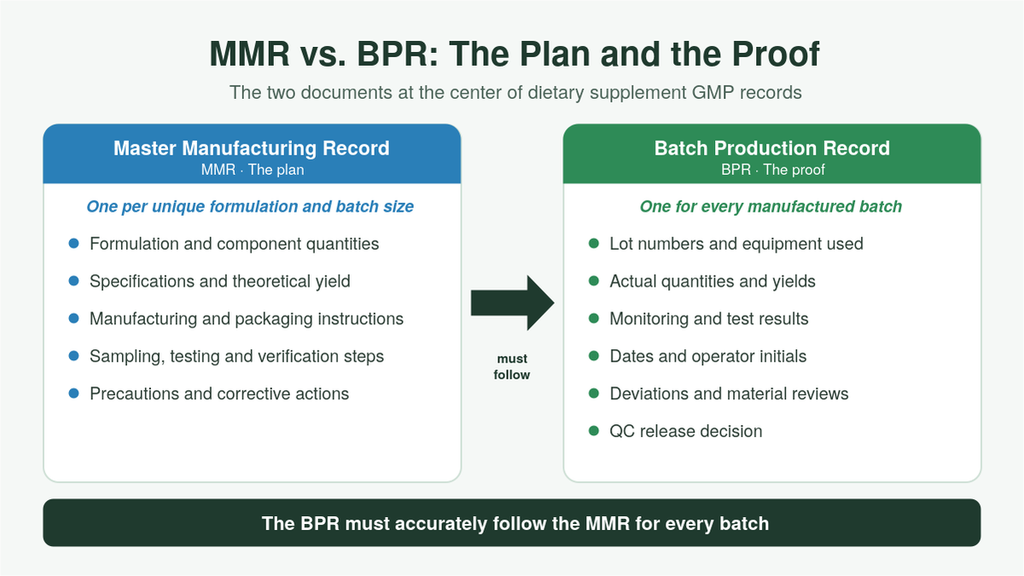
Two documents sit at the center of dietary supplement GMP documentation: the Master Manufacturing Record (MMR) and the Batch Production Record (BPR).
The MMR defines how a particular supplement and batch size should be manufactured. Part 111 requires a written MMR for each unique formulation and each batch size. It includes the formulation, component quantities, relevant specifications, theoretical yields, packaging information, manufacturing instructions, sampling and testing references, verification steps, precautions, and corrective-action provisions.
The BPR documents what actually happened when an individual batch was manufactured. A batch production record is required for every manufactured batch and must accurately follow the appropriate MMR. It captures information such as lot numbers, equipment used, component identifiers and quantities, yields, monitoring and testing results, manufacturing dates and operator initials, packaging and labeling information, deviations, material reviews, and quality-control release decisions.
How dietary supplement GMP works across a batch
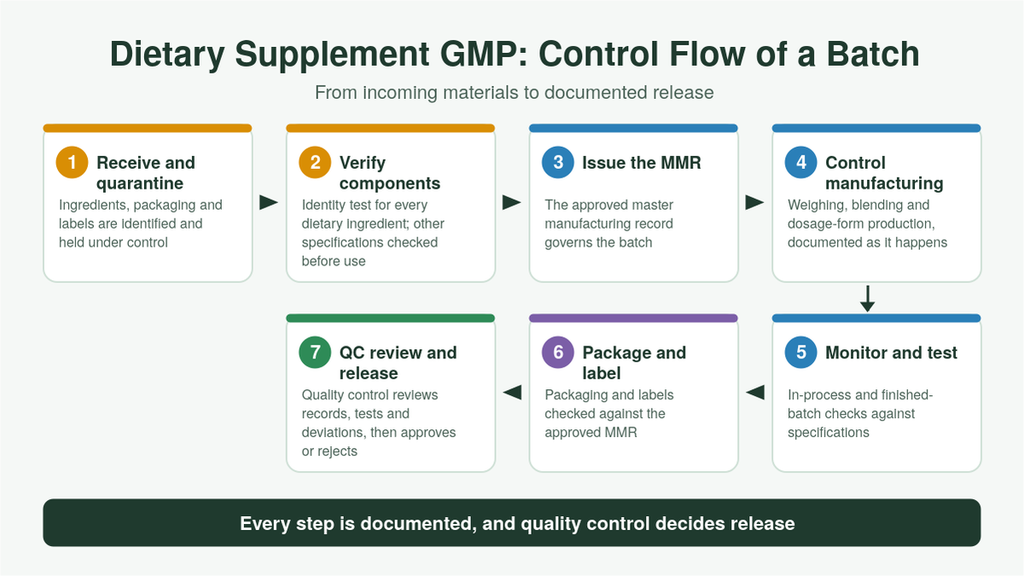
A well-controlled supplement manufacturing process creates a chain of documented decisions from raw-material receipt through final release:
- Receive and quarantine components. Incoming ingredients, packaging, and labels are identified and held under controlled conditions.
- Verify components against specifications. Required identity testing and other appropriate examinations are completed before components are released for use.
- Issue the approved manufacturing instructions. The correct MMR and associated procedures govern the batch.
- Control manufacturing. Weighing, dispensing, blending, dosage-form production, and other operations are performed using established controls and documented as they occur.
- Monitor and test. In-process and finished-product checks provide evidence that specifications and process requirements are being met.
- Package and label under controlled conditions. Packaging and labeling operations are checked against approved requirements.
- Quality review and release. Quality control reviews the required records, testing, deviations, and disposition decisions before the product is released for distribution.
What specifications should a supplement manufacturer establish?
Part 111 requires specifications wherever control is necessary to ensure product quality and correct packaging and labeling. This includes specifications for components, in-process production, labels and packaging, finished batches, and certain products received for packaging or labeling.
The precise testing program depends on the ingredient, formulation, manufacturing process, dosage form, identified risks, and specifications. A credible manufacturer should therefore be able to explain not just what it tests, but why the selected methods and sampling strategy are appropriate.
GMP requirements for different supplement dosage forms
The regulatory framework applies across dietary supplement formats, but the manufacturing controls needed to achieve a consistent product can differ substantially.
Capsules and tablets may require close control of blending, flow, fill or compression parameters, weight variation, and physical characteristics. Powders place particular emphasis on ingredient identity, segregation, blending uniformity, environmental controls, and prevention of cross-contamination. Gummies introduce process variables such as cooking, depositing, moisture, texture, and active incorporation. Liquids can require controls around mixing, pH, microbial risk, filling, and container closure.
GMP is therefore a regulatory framework rather than a single standardized manufacturing recipe.
Does an FDA registration mean a manufacturer is GMP certified?
No. FDA establishment registration, where applicable, should not be interpreted as FDA approval or as a general FDA-issued GMP certification. Registration identifies a facility to FDA. It is not an inspection or an approval of the facility’s processes or products.
Manufacturers may also hold third-party certifications or undergo independent audits against standards that assess GMP systems. These can provide useful additional evidence during supplier qualification, but they do not replace compliance with applicable FDA requirements.
How to evaluate a dietary supplement contract manufacturer for GMP
For a brand outsourcing production, asking whether a manufacturer is “GMP compliant” is only the beginning. Due diligence should examine how the quality system works in practice. Useful questions include:
- Which dietary supplement operations are performed at the facility?
- How are ingredient suppliers qualified and periodically reviewed?
- How does the manufacturer perform dietary ingredient identity verification?
- Which specifications and tests are used for the proposed formulation?
- Are laboratory tests performed in-house, externally, or through a combination of both?
- How are deviations, out-of-specification results, and material disposition decisions handled?
- Who has authority to release or reject a finished batch?
- How are MMRs and BPRs created, approved, controlled, and retained?
- How does the facility prevent allergen, microbial, chemical, or physical cross-contamination where relevant?
- What third-party audits or certifications does the site maintain?
- What is the facility’s FDA inspection history, where available?
- How are complaints, returned products, and traceability managed?
The answers should be evaluated in the context of the product. A manufacturer experienced in straightforward capsules may not automatically have the process capability required for complex gummies, probiotics, high-potency ingredients, botanical extracts, or other technically demanding products.
Common dietary supplement GMP problems
FDA warning letters provide recurring examples of where systems can break down. Cited problems include failure to conduct identity testing of a dietary ingredient before use, failure to prepare and follow a master manufacturing record for each formulation and batch size, and relying on certificates of analysis without qualifying the supplier. Other recurring issues include inadequate specifications, missing or incomplete batch production records, weak quality-control review, poor documentation, and failure to investigate deviations appropriately.
For brands, these failures can become commercial as well as compliance risks. Weak records can make an investigation or recall harder; inadequate controls can create batch-to-batch inconsistency; and poor supplier oversight can expose a product to substitution or contamination risks.
GMP documentation and record retention
Documentation is a core part of the control system. Part 111 requires records across training, equipment, specifications, supplier qualification, quality control, receiving, manufacturing, laboratory operations, packaging and labeling, and other activities.
Required records generally must be retained for one year past the shelf-life date when shelf-life dating is used, or for two years beyond the date of distribution of the last batch associated with those records. Reserve samples of each lot of packaged and labeled dietary supplements that are distributed must be held for the same period.
GMP as the foundation of supplement manufacturing
Effective GMP is not a final inspection added after manufacturing. It is the system connecting raw materials, people, equipment, processes, testing, documentation, packaging, and quality decisions throughout production.
For supplement companies choosing a contract manufacturer, the most useful question is therefore not simply whether the site claims GMP compliance. It is whether the manufacturer’s quality system, technical capabilities, documentation, and testing strategy are appropriate for the specific product being outsourced.
Frequently asked questions
What GMP regulations apply to dietary supplements in the United States?
FDA’s dietary supplement current Good Manufacturing Practice requirements are set out in 21 CFR Part 111 and apply to relevant manufacturing, packaging, labeling, and holding operations.
Is cGMP different from GMP?
The terms are often used interchangeably in industry. FDA uses “current Good Manufacturing Practice,” or cGMP/CGMP, emphasizing the expectation that appropriate current systems and controls are used.
Does every dietary ingredient need identity testing?
Part 111 requires at least one appropriate test or examination to verify the identity of each dietary ingredient that is a component of a dietary supplement, unless an applicable FDA-granted exemption applies.
What is a Master Manufacturing Record?
An MMR is the controlled manufacturing instruction for a dietary supplement formulation and batch size. It defines components, quantities, specifications, yields, manufacturing instructions, packaging requirements, and required controls.
What is a Batch Production Record?
A BPR is the contemporaneous record of the manufacture and control of a specific batch. It provides traceability for what materials, equipment, processing steps, results, personnel, and quality decisions were associated with that batch.
Are third-party GMP certifications required by FDA?
Third-party certifications can support supplier qualification and provide additional assurance, but a private certification is not a substitute for compliance with applicable FDA requirements under 21 CFR Part 111.