
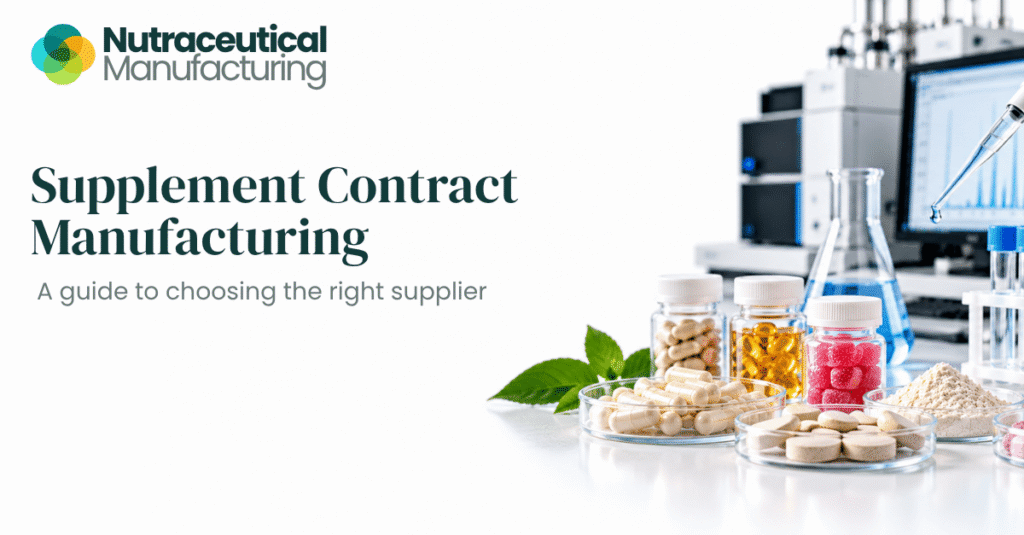
Supplement contract manufacturing is the outsourcing of dietary or food supplement production to a specialist third-party manufacturer. Depending on the agreement, the manufacturer may handle anything from ingredient sourcing and blending to formulation development, encapsulation, tableting, gummy or softgel production, testing, packaging and labelling.
For supplement brands, contract manufacturing can provide access to specialist equipment, formulation expertise, quality systems and scalable capacity without building and operating a manufacturing facility. But outsourcing production does not remove the brand owner’s responsibility for product quality and regulatory compliance.
What is supplement contract manufacturing?
A supplement contract manufacturer produces supplements on behalf of another company, typically a brand owner, retailer or distributor. The finished product is sold under the customer’s brand rather than the manufacturer’s own consumer brand.
The scope can range from a relatively simple manufacturing-only arrangement, where the customer supplies a finished formulation and specifications, to an end-to-end service covering product development, ingredient procurement, pilot work, commercial manufacturing, quality testing, packaging and documentation.
This makes “contract manufacturer” a broad term. Two manufacturers describing themselves in the same way may offer very different capabilities. One may specialise in powder blending and hard capsules, while another operates dedicated gummy, softgel or liquid lines and provides extensive formulation and regulatory support.
Supplement contract manufacturing market size
The global dietary supplements market was valued at USD 209.5 billion in 2025 and is projected to increase from USD 228.2 billion in 2026 to USD 431.7 billion by 2033, growing at a CAGR of 9.5% from 2026 to 2033 according to Grandview Research
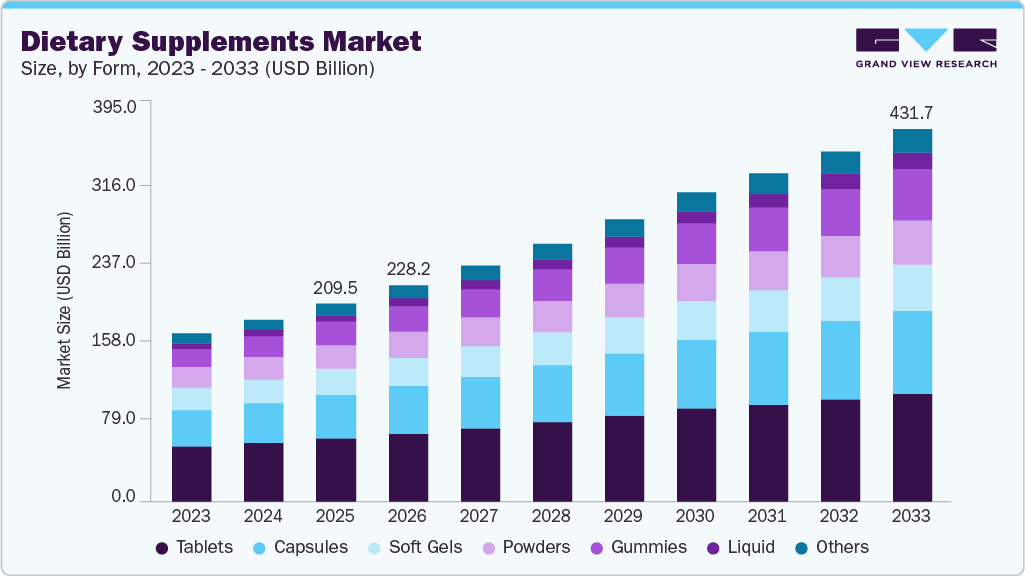
North America held the largest regional market share, accounting for 36.1% of global revenue in 2025. Market growth is driven by rising health consciousness, changing consumer lifestyles, and an increasing emphasis on preventive healthcare.
Why do supplement brands use contract manufacturers?
Building supplement manufacturing capability requires production equipment, premises, trained staff, quality systems, testing capability and working capital. Outsourcing allows a brand to access established infrastructure and specialist expertise while concentrating resources on product strategy, marketing and distribution.
The benefits can include faster access to manufacturing capacity, specialist dosage-form expertise, greater production flexibility, reduced capital expenditure and support with formulation, ingredient sourcing, packaging and quality documentation.
Outsourcing also creates dependencies. A manufacturer’s capacity, raw-material controls, quality performance, lead times and communication become part of the brand’s supply chain. Selecting and managing the manufacturing relationship therefore has direct implications for product quality and continuity of supply.
Latest Nutraceuticals News-
- Dyadic Targets 200 Metric Tons in Alpha-Lactalbumin Deal

- Biofarma Group Takes 70% Stake in EuroPharma Alliance

- Solabia Takes Majority Stake in Ethical Naturals

- Conch Lifescience Raises Tablet Capacity to 300,000
- AstaReal Extends EB15 Astaxanthin to Human Supplements
- Catalent Names Wetteny Joseph to Lead Pharma and Consumer Health

What services does a supplement contract manufacturer provide?
Services vary considerably by manufacturer and project. An integrated partner may support the product across most of its lifecycle.
Formulation and Product Development
- Translate product concepts into manufacturable formulations.
- Select ingredient forms, excipients, and appropriate serving sizes.
- Assess ingredient compatibility and potential interactions.
- Develop product flavor, texture, and overall sensory characteristics.
- Produce samples and pilot batches for evaluation.
Ingredient Sourcing and Qualification
- Source vitamins, minerals, amino acids, botanicals, proteins, probiotics, oils, flavors, sweeteners, and functional excipients.
- Qualify suppliers and verify raw material identity and quality.
- Review specifications and certificates of analysis (CoAs).
- Maintain raw material traceability and documentation.
Manufacturing
- Select production processes based on the dosage form.
- Perform weighing, dispensing, milling, sieving, blending, and granulation.
- Manufacture tablets through compression and capsules through encapsulation.
- Support specialized formats such as gummies, softgels, powders, and liquids.
- Conduct filling and other production operations as required.
Testing and Quality Control
- Verify ingredient identity and potency.
- Conduct assay and microbiological testing.
- Test for heavy metals and other relevant contaminants.
- Assess physical characteristics and finished-product specifications.
- Apply testing requirements based on product risks, ingredients, and target markets.
Packaging and Labeling
- Provide bottles, pouches, sachets, stick packs, blister packs, and tubs.
- Perform filling, labeling, batch coding, and secondary packaging.
- Select packaging to protect against moisture, oxygen, and other factors that can affect shelf life.
- Ensure packaging and labeling meet applicable market requirements.
Supplement manufacturing by dosage form
Tablets
- Produced by compressing prepared powders or granules into a defined shape and weight.
- Require suitable powder flow, compressibility, ingredient compatibility, and blend uniformity.
- May include coatings for appearance, taste masking, protection, or functional purposes.
Hard Capsules
- Commonly filled with powders or granules using gelatin or non-animal shell materials such as HPMC.
- Require reliable powder flow and accurate fill-weight control.
- Formulations must deliver the intended ingredient quantity within the available capsule volume.
Powders
- Widely used in sports nutrition, protein, collagen, greens, hydration, and other supplement products.
- Require consistent blending, flavor, solubility or dispersibility, and moisture control.
- Packaging plays an important role in maintaining product quality and shelf life.
Gummies
- Combine supplement formulation with confectionery-style manufacturing processes.
- Require careful management of active ingredient stability, texture, flavor, and water activity.
- Gelling systems, such as pectin and gelatin, and heat-sensitive ingredients can introduce formulation challenges.
Softgels
- Particularly suitable for oils and lipid-based formulations.
- Require specialized encapsulation equipment and expertise.
- Manufacturing involves controlling both the fill formulation and the gelatin or alternative shell system.
Contract manufacturing vs private label vs white label
These terms are often used loosely, but they describe different levels of product customisation.
|
Model |
Typical approach |
Customisation |
Best suited to |
|---|---|---|---|
|
Contract manufacturing |
Product manufactured to an agreed customer specification |
Potentially high |
Brands seeking a differentiated product |
|
Private label |
A manufacturer supplies an established or semi-custom product under the customer’s brand |
Low to moderate |
Brands prioritising faster development |
|
White label |
A largely standard product is offered to multiple customers with different branding |
Usually low |
Rapid launches and lower development requirements |
Terminology is not completely standardised across the industry, so buyers should establish exactly what formulation ownership, exclusivity and customisation are included in a manufacturer’s proposal.
From concept to commercial supplement: the contract manufacturing process
- Product brief: define target consumer, ingredients, claims, dosage form, serving size, target markets, volumes and commercial objectives.
- Feasibility and formulation: assess ingredient compatibility, dose, manufacturability, flavour and format.
- Raw-material sourcing: identify suppliers and establish ingredient specifications and documentation.
- Sampling and pilot work: manufacture development samples and refine the formulation where required.
- Specifications and packaging: agree finished-product requirements and select primary and secondary packaging.
- Commercial manufacturing: weigh, blend and process the formulation using the appropriate dosage-form equipment.
- Quality testing and release: evaluate the batch against established specifications and complete required documentation.
- Packaging and shipment: fill, label, code, pack and release finished goods for distribution.
Quality and regulatory considerations
The regulatory framework depends on where a supplement will be sold. In the United States, dietary supplement manufacturing, packaging, labelling and holding are subject to FDA dietary supplement current Good Manufacturing Practice requirements in 21 CFR Part 111.
An important point for brands is that manufacturing can be outsourced, but regulatory responsibility cannot simply be transferred to the contractor. FDA guidance states that a distributor contracting out manufacture must know how manufacturing activities are performed so it can determine whether products conform to specifications and can be approved and released.
Third-party standards can add another layer of supplier qualification. NSF/ANSI 455-2, for example, is a GMP certification standard covering facilities involved in manufacturing, packaging, warehousing and distribution of dietary supplements.
In the UK, food supplements are regulated as foods rather than medicines and must comply with general food law and specific composition and labeling requirements. UK rules also prohibit claims that a food can treat, prevent, or cure disease. In the EU, food supplements are governed by harmonized requirements under Directive 2002/46/EC, alongside broader food legislation.
How to choose a supplement contract manufacturer
The right partner depends on the product rather than on a generic ranking of manufacturers. A buyer should first establish which capabilities are essential and then verify them during qualification.
1. Does the manufacturer actually specialise in your dosage form?
Ask which products are made in-house, which processes are subcontracted, what equipment is used and what comparable products the facility routinely manufactures.
2. How robust is the quality system?
Review relevant GMP status and third-party certifications, audit history where available, quality agreements, deviation and CAPA processes, batch documentation, supplier qualification and finished-product release procedures.
3. What testing is performed?
Establish what the manufacturer tests internally and externally, which methods and laboratories are used, how ingredient identity is confirmed, what contaminant testing is risk-based, and how finished-product specifications are established.
4. How are ingredients sourced and controlled?
Understand approved-supplier procedures, traceability, country of origin where relevant, ingredient lead times, change controls and how the manufacturer handles branded or customer-nominated ingredients.
5. What are the MOQ and batch-size constraints?
Minimum order quantities vary by process, formula and packaging configuration. Rather than comparing MOQ in isolation, ask about minimum economical batch size, pilot options, scale-up increments and how packaging MOQs affect the finished order.
6. What are realistic development and production lead times?
Lead time is affected by formulation work, raw-material availability, testing, packaging components, production scheduling and batch release. Ask manufacturers to separate development, procurement, manufacturing, testing and packaging time rather than providing one headline number.
7. Can the manufacturer scale with the brand?
Assess current and available capacity, equipment scale, campaign sizes, peak-season constraints, second-source options and what happens if demand grows substantially beyond the initial forecast.
8. Who owns the formula and intellectual property?
Contracts should make formula ownership, confidentiality, exclusivity, tooling and access to technical documentation explicit. This becomes particularly important when a manufacturer contributes substantial development work.
Red flags when evaluating a supplement contract manufacturer
A good manufacturer is willing to be examined. The following warning signs should prompt further questions before you commit:
- Price is the main selling point
- Reluctance to share documents or permit an audit
- Vague answers about subcontracting
- Weak handling of deviations and complaints
- High staff turnover
- Generic analytical methods
- Inflexible contract terms
- Capacity promises without evidence
How to qualify a supplement contract manufacturer: a step-by-step approach
A structured qualification process turns the questions above into evidence. A practical sequence is:
- Shortlist against the product brief. Screen on dosage form, target market, certifications and typical batch size before any detailed discussion.
- Sign a non-disclosure agreement. Share the brief, volumes and specifications only once confidentiality is in place.
- Issue a written request for quotation. Provide the same specification, packaging format and forecast to every shortlisted supplier so that proposals can be compared like for like.
- Send a supplier questionnaire. Cover quality system, testing, subcontracting, ingredient controls, recall procedures and regulatory history.
- Review documents. Check GMP certificates, third-party audit reports, sample batch records, certificates of analysis and the finished-product specification.
- Audit the site. Audit before you select, either yourself or through an independent auditor, and build periodic audits into the contract.
- Agree a quality agreement. Set out responsibilities for specifications, change control, deviations, complaints, recalls and batch release (see below).
- Run a pilot or first commercial batch. Confirm that the product meets specification, that the documentation is complete and that the supplier meets agreed timelines.
- Monitor performance. Track on-time delivery, right-first-time batches, deviations, complaints and responsiveness, and review them at scheduled meetings.
What should a quality agreement and supply contract cover?
A supply agreement sets out the commercial terms; a quality agreement defines who is responsible for what in quality and compliance. The two should be consistent. At a minimum, consider the following:
- Specifications and testing: raw-material, in-process and finished-product specifications; which party tests what; and acceptance criteria.
- Batch release: who reviews batch records and certificates of analysis and who has final authority to release product.
- Change control: advance notice and approval for changes to ingredients, suppliers, processes, equipment, sites and packaging components.
- Deviations, out-of-specification results and CAPA: notification timelines, investigation expectations and how corrective actions are verified.
- Complaints, adverse events and recalls: responsibilities, response times and traceability exercises.
- Audit rights: frequency, notice periods and access to records and sub-contractors.
- Subcontracting: which activities may be subcontracted, with what approval.
- Intellectual property and confidentiality: formula ownership, process improvements, exclusivity and what happens to documentation if the relationship ends.
- Commercial terms: forecasting, MOQ, lead times, price review, raw-material liability, remedies for late delivery and termination provisions.
- Regulatory responsibilities: which party holds which registrations and documentation for each target market.
Questions to ask a supplement contract manufacturer
- Which dosage forms and manufacturing steps are performed in-house?
- Which certifications and regulatory standards apply to the facility?
- Can we audit the manufacturing site?
- How do you qualify ingredient suppliers?
- What identity, potency, microbiological and contaminant testing will be performed?
- Which tests are conducted in-house and which are outsourced?
- What is the MOQ for this exact formulation and packaging format?
- What are the expected development, manufacturing and release timelines?
- How do you manage deviations, out-of-specification results and CAPAs?
- How are formula changes and ingredient substitutions controlled?
- What documentation accompanies each batch?
- Who owns the formulation and development work?
- What capacity is available if volumes increase?
- What elements of the project will be subcontracted?
Conclusion
Supplement contract manufacturing gives brands access to manufacturing infrastructure and specialist expertise without owning a production facility, but the relationship reaches far beyond simply placing a purchase order. Formula development, ingredient controls, process capability, testing, quality systems, regulatory requirements and supply reliability all affect the finished product.
The strongest manufacturer is therefore not necessarily the largest or the lowest-cost provider. It is the partner whose technical capabilities, quality systems, capacity and commercial model fit the specific supplement being developed and the markets in which it will be sold.
Frequently asked questions
What does a supplement contract manufacturer do?
A supplement contract manufacturer makes products on behalf of a supplement brand, retailer or distributor. Services can include formulation, ingredient sourcing, blending, encapsulation or tableting, gummy and softgel production, testing, packaging and labelling.
What is the difference between contract manufacturing and private label supplements?
Contract manufacturing commonly involves producing to a customer’s agreed formulation and specifications, while private label typically starts with an existing manufacturer formulation that is sold under the customer’s brand. In practice, suppliers use the terms differently, so the degree of customisation and formula ownership should always be confirmed.
What is the minimum order quantity for supplement manufacturing?
There is no standard MOQ. It varies by dosage form, equipment, formulation, ingredient quantities and packaging. A manufacturer may quote an MOQ in capsules, bottles, kilograms or finished units. Buyers should also ask about pilot batches and packaging-component minimums.
How long does contract supplement manufacturing take?
A repeat order using available ingredients and packaging can be substantially faster than a new custom formulation. New projects may require formulation, samples, ingredient procurement, packaging development, manufacturing, testing and release. The most useful timeline separates each of these stages and identifies the critical-path materials.
What certifications should a supplement contract manufacturer have?
The answer depends on the product and destination market. Buyers should first verify compliance with applicable legal manufacturing requirements, then consider relevant third-party schemes and commercial requirements such as NSF/ANSI 455-2, retailer standards, organic certification, halal, kosher or sport-specific certification where needed.
Can a contract manufacturer develop my supplement formula?
Many full-service manufacturers provide formulation and R&D, but capability varies. Some primarily manufacture customer-supplied formulas, while others develop products from an initial brief. Establish who owns the resulting formulation and technical documentation before development begins.
Are supplement brands still responsible for products made by a contract manufacturer?
Yes, regulatory responsibilities cannot necessarily be transferred simply by outsourcing manufacturing. In the United States, FDA specifically states that a distributor using a contract manufacturer has obligations to understand manufacturing activities and ensure products released under its name meet applicable specifications and CGMP requirements.
How should I compare supplement contract manufacturers?
Compare manufacturers against a defined product specification. Important criteria include dosage-form expertise, quality systems, testing, ingredient controls, capacity, MOQ, lead times, scalability, regulatory experience, communication, documentation and the manufacturing steps actually performed in-house.
What is a quality agreement, and do I need one?
A quality agreement is a written document that allocates responsibility for quality-related activities between the brand and the manufacturer, including specifications, batch release, change control, deviations, complaints and recalls. Because the brand remains responsible for the product it sells, a quality agreement is strongly advisable for any outsourced arrangement, and many manufacturers and retailers expect one.
Do I need a UK-based manufacturer to sell supplements in the UK?
Not necessarily. However, the Food Standards Agency states that a business importing supplements into the UK is legally responsible for the composition, safety and labelling of those goods. A brand using an overseas manufacturer should therefore verify that the product meets UK requirements and hold the supporting documentation.
Can I change manufacturer later?
Yes, but it is rarely simple. A change typically involves transferring the formula, specifications and process knowledge, repeating pilot work and requalifying ingredients and packaging. Having clear formula ownership, complete technical documentation and a contractual transfer of records makes any future move far easier, and it is one reason to settle those points before the first batch.